

You could easily walk right past it: a few green blades sticking out of the water at low tide. Yet, according to scientists, seagrass is just as important as a coral reef. The problem is that more than 90% of the Netherlands’ seagrass beds have disappeared. So, in collaboration with Purina, we put on our wellies and headed out into the Oosterschelde with the Sea Rangers and researchers from the University of Groningen. After all, how do you actually restore a seagrass bed that’s disappeared?
Why seagrass is so desperately needed
Wellies on, rain jacket zipped up and off to the south. Together with the Sea Rangers, researchers from the University of Groningen and Rijkswaterstaat headed into the seagrass meadow to discover what exactly grows here. Lesson one: seagrass is not seaweed, but a flowering plant with roots that can form entire fields underwater. Various marine animals find food and shelter there, and young fish a safe place to grow up. Moreover, seagrass keeps silt in place, dampens waves and currents, and sequesters carbon. And not just a little bit, either. ‘Seagrass can sequester carbon up to 35 times faster than tropical rainforests,’ says seagrass researcher Laura Govers. Due to pollution, climate change, and increasingly intensive use of the sea, a lot of seagrass has disappeared worldwide. Once gone, it does not simply return. That is why the Sea Rangers and the researchers are assisting with restoration in various places in Europe, including the Oosterschelde.


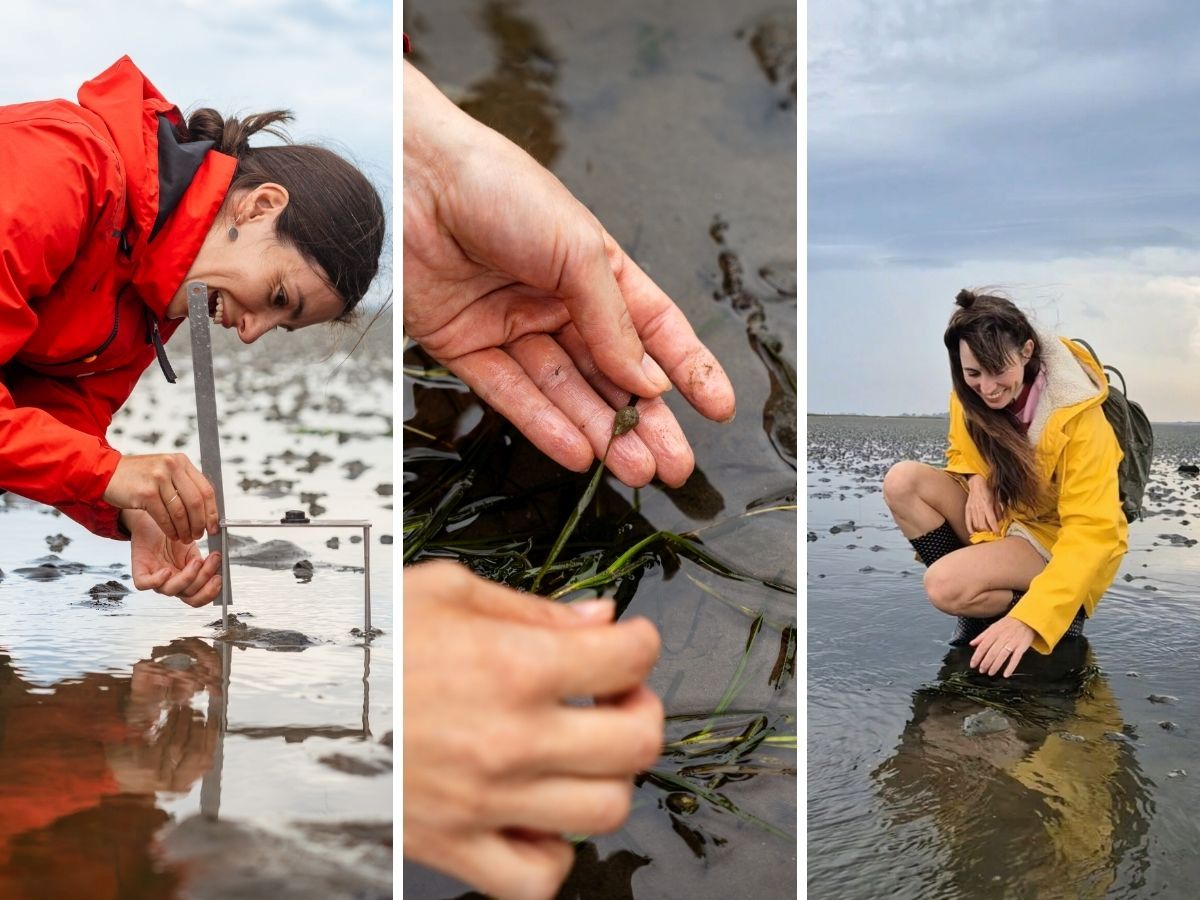
Sea Rangers are taking a close look at how the seagrass is doing. The young plants are fragile and are therefore closely monitored.
Creating a seagrass meadow is a major operation
Throwing a handful of seeds into the Oosterschelde and letting nature do the rest is unfortunately not that simple. Bringing back seagrass can roughly be done in two ways: by injecting seeds into the seabed or by relocating complete seagrass sods. At the location we visited, this is done using seeds of annual dwarf eelgrass. This dies off after the summer and therefore has to sprout again from seed the following spring. Because there is still too little seagrass growing to supply enough seed, the Sea Rangers source this from healthy fields elsewhere in Europe such as Cantabria, Denmark and Northern Germany. The new plants then produce seeds themselves, from which hopefully an even larger field will grow the following year. It works differently with perennial small eelgrass, as we learned when we stood on the seabed. There, circular sods are relocated, plants, roots and soil and all. Since 2023, more than 150 thousand seeds have already been injected in this way and over 13.5 thousand seagrass sods planted out. Conclusion: bringing back seagrass is a massive job. You need many hands, extensive research and quite a lot of money.
Laura and her colleagues from the University of Groningen are investigating which method has the best chance of success in which location. The Sea Rangers and researchers then stand knee-deep in the mud with their boots on to sow, plant and monitor. ‘The Netherlands has been working on seagrass restoration since the 1950s,’ Laura explains. ‘We are leaders in this field. The whole world is watching what we are doing here in the Netherlands.’ Purina is involved as a partner in the restoration of seagrass in the Oosterschelde. That involvement is no coincidence. Purina uses fish in cat food, especially catch by-products such as heads and organs. These actually contain important nutrients for cats. Part of that fish carries the MSC label. But Purina doesn't just want to use more sustainably caught fish, the company also wants to contribute to the recovery of the ecosystem from which that fish comes. That is why Purina supports various projects in Europe that restore seagrass beds, oyster reefs and kelp forests, including the work of the Sea Rangers in the Oosterschelde.


To measure is to know: the Sea Rangers are mapping where the seagrass is growing and how the bed is developing.
Sea Ranger: a dream job?
Being paid to work outdoors in nature, planting seagrass and, at the same time, learning to work at sea: we can think of worse jobs. The Sea Rangers we meet are mostly young people who help researchers with planting and monitoring seagrass. Behind this dream job lies a social purpose too. The Sea Ranger Service creates employment opportunities in coastal areas by recruiting young people aged 18 to 29 and preparing them for paid work at sea through an intensive boot camp. You don’t need to be a biologist or an experienced seafarer to do this. Those selected are offered a full-time contract, gain work experience and can then pursue a career in the maritime sector. Veterans from the navy help with the training. And there’s no shortage of female interest: over 70% of the candidates are women, whilst the maritime sector is still predominantly a man’s world. Great!
1,500 hectares of seagrass meadows, oyster reefs and kelp forests
As the water slowly rose again and thunderstorms threatened, it was time for us to leave the seagrass meadow. For the Sea Rangers and researchers, the work will simply continue over the coming years. Seagrass restoration is now underway across a total of eight hectares at two promising locations in the Oosterschelde. The researchers are monitoring which plants survive and spread, as well as which marine life is attracted to them. What they learn here can then be applied to restoration projects elsewhere in Europe. Through the wider European restoration programme, Purina aims to have contributed to the restoration of 1,500 hectares of seagrass meadows, oyster reefs and seaweed forests by 2030. That is roughly equivalent to 2,300 football pitches. It is a significant goal because, as Laura emphasised to us, seagrass restoration requires a lot of patience. But once all those little green shoots form complete meadows again, it will be more than worth the toil in the Zeeland mud!
You might also find this interesting
- Also see: On a game picking walk!
- Also see: on a city break in Dokkum.
Photo credits: Anne Dijkstra, Creativebros.