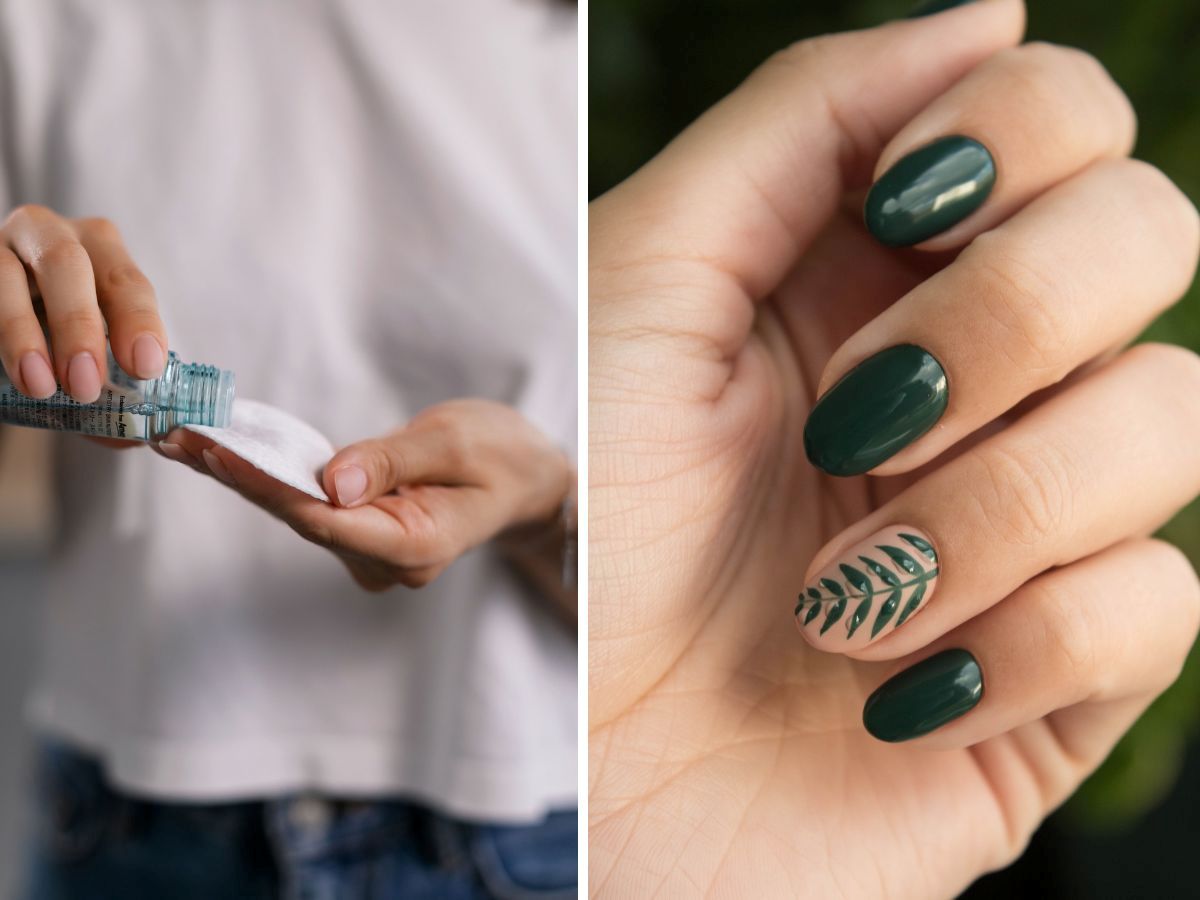

Nail polish remover. As soon as you read the word, you probably already smell it. What a stench that stuff is! Those fumes can irritate your eyes and airways, and acetone can dry out your nails and skin severely. Can’t remove nail polish in a greener, fresher way? Absolutely! We have a whole list of milder nail polish removers for you. But we hasten to add: being acetone-free doesn’t automatically mean sustainable.
One nail polish remover is not the same as another, as we learned
Many ‘regular’ nail polish removers have acetone as the main ingredient. It works like a solvent because acetone dissolves the substances that make your nail polish hard. But it not only removes your nail polish; it also dissolves oils on your skin and nails. Hello, that familiar white haze! Moreover, acetone evaporates quickly and can irritate your eyes, nose, and throat. No need to panic if you occasionally remove your nail polish and use the product according to the instructions. Just open a window for a moment, turn the cap back on the bottle immediately, and stay away from candles and other sources of ignition. Nail polish removers are usually highly flammable. Read more about nail polish remover.
Acetone, acetone-free or biobased: which do you choose?
Fortunately, there are more and more alternatives. In the store you encounter roughly three types: remover with acetone, acetone-free remover with another solvent, and remover with solvents that are entirely or partially made from renewable raw materials. A bottle often prominently states ‘without acetone’. That sounds a lot friendlier, but turn the packaging over as well. The active ingredient is often ethyl acetate. That usually smells a little less pungent than acetone and may be more pleasant for some people to use, but it remains a volatile and flammable solvent that can irritate your eyes. It is therefore not the same as being harmless or sustainable.
Biobased nail polish remover
Removers sold as natural or biobased use, for example, alcohol, ethyl lactate, diethyl succinate or another solvent that can be made from plant-based raw materials. Ethyl lactate can, for example, be produced from lactic acid and alcohol, derived from fermented sugars. It is well biodegradable. However, ‘biobased’ is not a green guarantee label either. It says something about the origin of a raw material, but not how much energy and agricultural land were needed for its production, how the product is packaged or how it has traveled. And of course, that does not automatically mean that something cannot cause irritation. For example, essential oils can contain allergens.
Reading glasses: is ethyl acetate or ethyl lactate mentioned?
Do you dare to look at the small print on the ingredients list? Then be careful, because ethyl acetate and ethyl lactate look quite similar in name. Haha, a fun pun. They are both solvents: liquids that remove the hard nail polish so you can wipe it off. Only they do it a little differently.
Ethylacetate It is the substance you often encounter in ‘regular’ acetone-free nail polish remover. It evaporates quickly and usually dissolves the nail polish easily. Handy, but it still has a distinct solvent smell, can dry out your skin and nails, and can irritate your eyes.
Ethyllactic acid, Also written as ethyl lactate, it does the same job, but evaporates less quickly. As a result, a remover often smells less sharp and you usually have to leave the remover on your nail for a little longer. Ethyl lactate can be made from lactic acid and alcohol from fermented sugars and is well biodegradable. Therefore, it is often used in biobased nail polish removers.
In short: ethylacetate is usually the fast, acetone-free option and ethyllactic acid The somewhat slower, often biobased option. But ethyl lactate also remains a solvent that can be irritating and flammable. Therefore, biobased does not automatically mean harmless or completely sustainable.
Making your own nail polish remover? These tricks work, but only moderately
You’re out of remover and you still want to get rid of your nail polish? Online home and kitchen tips fly in from all directions. A thick, new coat of nail polish can indeed temporarily soften the old one, so you can quickly remove both layers. But it’s not really sustainable: you use extra nail polish and get household solvent fumes again. Lemon juice with vinegar is also often mentioned. Don’t expect miracles from that. It doesn’t contain the solvents that ordinary nail polish quickly dissolves. Disinfecting alcohol of 70% can sometimes be useful, but it usually works slowly and is also flammable. Vodka usually contains too little alcohol to be a useful remover. Our advice: let the polish sit for a while until you have some remover again.
Our list of milder and biobased nail polish removers
Many removers on this list do not use acetone and contain entirely or partially plant-based or organically grown ingredients. That makes them interesting as an alternative, but without a full life cycle analysis we cannot say which bottle is the most sustainable at the bottom line. Prices, stocks and ingredients can change. Therefore, always check the current ingredient list before ordering. And first, check what you already have at home. Throwing away half a bottle to buy a ‘greener’ one is of course not very cost-effective.
Deodorants with ethyl lactate and/or biological alcohol
- Benecos Has several nail polish removers. The Soft Natural variant contains alcohol, ethyl lactate, glycerin, and orange and lavender oil. Note: The Express variant contains ethyl acetate. So be sure to choose the right bottle.
- Sante produces an acetone-free remover with organic alcohol, ethyl lactate, castor oil and orange oil.
- Kia-Charlotta Uses ethyllactate with jojoba and avocado oil. The scent comes from eucalyptus and lemon grass oil, among other things.
- Provida It is a remover based on organic alcohol and various citrus and plant oils. Part of the ingredients are Demeter-certified.
- Boho It has a remover with ethyl lactate, alcohol from organic raw materials, organic castor oil, apricot kernel oil and vitamin E. The formula is COSMOS Organic-certified.
- ZAO It keeps things remarkably simple: the remover consists of alcohol and ethyl lactate. According to the brand, the formula is 100% natural, vegan, and organically certified.
- Piggy Paint It is a product made from corn alcohol, aloe vera and vitamin E. The remover is acetone-free and specially formulated for the brand's water-based nail polish.
Removers with other solvents of natural origin
- Fresh Therapies Uses a mix of solvents including lemon oil. Availability varies and the product no longer seems to be available in every product range.
- Kure Bazaar It comes in several variants. The rosewater remover contains, among other things, diethylsuccinate, rosehip oil and rosewater. There are also formulas with rosemary and a gel remover with bamboo extract.
- Gitti has an acetone-free remover based on gamma-valerolactone, supplemented with jojoba, argan and lavender oil. According to the brand, the formula is 100% natural and vegan.
- SAME produces an oily remover with diethylsuccinate derived from wheat, corn and sugar cane, sweet almond oil and vitamin E.
Acetone-free, but not automatically green
- SOPHi remover gel Thanks to its gel structure, it stays firmly attached to your nail. The active ingredient is methyl acetate, a volatile and flammable solvent. It is easy to use and does not require acetone, but it is not necessarily a sustainable choice.
This is how to use nail polish remover smarter
A remover without acetone usually takes a little longer. Wet a cotton pad thoroughly, press it against your nail for about 20 to 30 seconds, and then wipe the polish off. This way you won’t have to scrub as hard and you’ll often use less product as well. Always follow the instructions on the packaging, though, because the curing time varies depending on the formula.
A few simple tips:
- Open a window during removal.
- Immediately turn the cap back on the bottle so that the solvent does not evaporate unnecessarily.
- Keep any remover away from fire, sparks and heat.
- Do not use more product or wipes than necessary.
- Check whether the remover is suitable for your type of nail polish. Ordinary natural removers often do not work on gel nails, acrylic nails or UV-gel nails.
Which sustainable nail remover do you choose?
A remover with acetone works quickly, but can severely dry out your skin and nails and has a sharp smell. A remover without acetone often contains ethyl acetate: perhaps more pleasant to your nose, but not automatically green. If you want an alternative based on renewable raw materials, look for a remover with, for example, ethyl lactate, organic alcohol or diethyl succinate.
Expect that you might need a little more patience sometimes. And remember: ‘naturally’, ‘acetone-free’ and ‘biobased’ only tell part of the story. First, figure out what you have and then choose a formula that works efficiently; that remains a great plan.
Do you have any other tips for a good nail polish remover? Let us know! We’ll see if it fits into this list.
You might also find this interesting
- Also see: Is there sustainable nail polish?
- Also see: How does nail polish remover work exactly?
- Also see: How sustainable and healthy are gel nails?
Sources: ATSDR, CDC/NIOSH, PubChem, ECHA. Photo credits: Alena Darmel, Pexels (remover in hand), Kristina Paukshtite, Pexels (green nails).