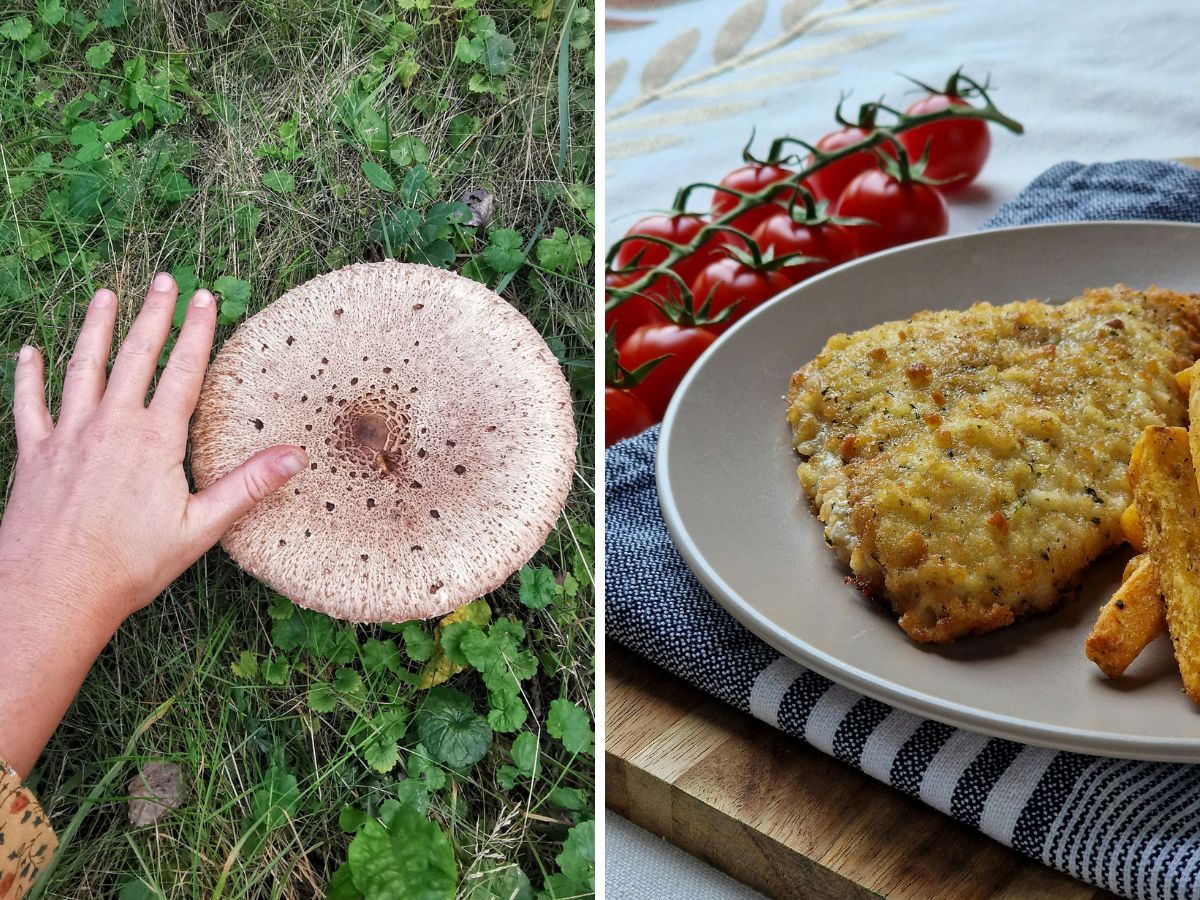
This is truly a favourite foraging recipe from our foraging expert Katja Wezel: a vegetarian schnitzel made from a large parasol mushroom that you can track down yourself. And no stress: Katja explains step by step how to recognise, pick and prepare it. Find that a bit daunting after all? We completely understand. Just replace the wild-foraged mushroom with a nice oyster mushroom from the supermarket or home-grown. Also mega tasty and always a safe choice.
parasol mushroom vegetarian schnitzel
For mushroom foragers, the parasol mushroom is a true classic. Not only because it is so large and striking, but also because it is surprisingly delicious: mild, nutty and perfect for breading like a schnitzel. At the same time, foraging for wild mushrooms always requires extra care, as there are species that can look similar. That is why we first list how to recognise the parasol mushroom and forage for it safely, and then we head into the kitchen.
Identifying the parasol mushroom
The parasol mushroom is one of the largest edible mushrooms that you can find in the Netherlands. It is an agaric, with distinct gills on the underside of the cap. The cap can grow up to 30 centimetres in diameter and the stalk can be 15 to 40 centimetres high. A real bobby-dazzler, then! You can recognise it by its cream-coloured to pale brown cap with brown scales. In the centre of the cap there is often a larger brown patch and towards the edge the scales become progressively finer. Young specimens still have a closed, smoother cap and look a bit like a drumstick.
The stem is also an important identifying feature: it has a burst zigzag pattern. And be sure to look closely at the ring: the parasol mushroom has a double ring that you can easily detach and which you can often slide up and down the stem. Underground, the stem is bulbous.
You can come across the parasol mushroom in late summer and autumn in the dunes, along the edges of woods and in open areas. It also grows in moderately damp grassy areas and meadows, often on nutrient-rich sandy soils. Sometimes it grows alone, but often in groups too. And as an added bonus, you regularly see it in fairy rings.
Picking parasol mushrooms
Because of its size, the parasol mushroom is often easy to recognise, but that doesn't mean you can just pick it blindly. When identifying it, you need to stay sharp, because there are species that can look somewhat similar. Think of the shaggy parasol (which can cause stomach upsets in some cases) and various amanitas, including the panther cap (which is even toxic).
Always look out for these features with the parasol mushroom: a double ring that comes away easily and can be slid up and down, the burst zigzag pattern all over the stalk, and of course the size of the mushroom. Also check the flesh: when cut, it remains white to cream and changes colour not Pink or red. In doubt? Leave it.
Found one? Then carefully cut it at the bottom of the stem, just above the ground. Make sure there is no dirt left on the stem, so that sand and grit don't spread between the gills. That will save you a lot of cleaning work later. Only choose specimens that are still firm. It's better to leave mushrooms that are old, limp, wet or nibbled.
Tip: help nature when you forage
Fungi reproduce via spores: tiny ‘seeds’ that you cannot see with the naked eye. In agaric fungi such as the parasol mushroom, these spores are located between the gills under the cap. As soon as the cap opens, wind, rain and animals help to disperse them. And if you pick a ripe mushroom? Then you can also lend a hand in dispersing spores (by gently moving it about). Once these end up in the ground, new mycelium can form and new mushrooms will grow there later.
Vegetarian schnitzel made from oyster mushroom (or self-picked) parasol mushroom
Kitchenware
- kitchen roll
- knife
- 2 soup or pasta bowls
- frying pan
- spatula
- oven (only if you want to dry the stem)
- pot for storing the powder
Ingredients
- 2 young open parasol mushrooms
- 1 hi
- 1 el milk
- 2 slices of stale bread or 2 rusks
- oil or butter
- thyme or rosemary
- salt and pepper
Instructions
- Are you using a supermarket oyster mushroom? Wipe it clean with kitchen paper (preferably no water, otherwise the mushroom quickly becomes soggy) and tear or cut it into nice schnitzel-sized pieces. Are you getting to work with your own hand-picked parasol mushroom? Then check extra carefully first whether you really have the right mushroom in front of you (doubt = leave it be). Then wipe the cap clean with kitchen paper (preferably no water here too) and check that there are no bugs between the gills. Are you in doubt whether the inside of the cap has been nibbled? Cut it open: then you will see for yourself whether tunnels have been eaten into it.
- Mix the egg with the milk, the thyme or rosemary and salt and pepper to taste.
- Crumble the bread or rusks in a separate container.
- Heat oil or butter in a frying pan. Meanwhile, coat both sides of the caps in the egg mixture. Then coat them in the crumbs and place them in the hot pan.
- Fry them until cooked on both sides in about 5 minutes. Ready to eat. Enjoy and bon appétit!
- Tip: don't throw away the stalk of the parasol mushroom! Remove the stalk from the cap. You can dry the stalk (at about 50°C in the oven) and then grind it into powder. Store this powder in a sealed jar and use it later as a seasoning in, for example, a stock, soup or risotto.
Neat game picking
Picking mushrooms is great fun to do, but don't forget: foraging in the wild is officially forbidden in the Netherlands and is often only tolerated. In some places stricter rules apply or it is strictly prohibited. You are also not allowed to pick certain species. Therefore, always forage with respect for nature: only for your own use, never take more than you need and leave enough for animals and other nature lovers. Want to know more about what to look out for? Here is a handy overview of the game picking rules.
Would you also like to go on the road with Katja? Check out her website wilderlust.nl with all the information about its wild-picking walks and courses.
You might also find this interesting
- Also see: candied green figs.
- Also see: green tomato chutney.
- Also see: chestnut and wild mushroom soup.
Photo credits: left: Wilderlust (mushroom), right: Nour Alhoda, Pexels (schnitzel).