
Giving up your dirty underwear for science. It sounds like a joke, but at the University of Amsterdam they are investigating which microfibres are released when clothes are washed. In the case of synthetic fabrics, such as polyester, these are microplastics that are washed away with the washing water. Saskia takes a look at the research and talks to Allison about what comes out of our laundry.
Big problem: microplastics from washing your clothes
With a wash, you remove more than just dirt and sweat. Your clothes themselves also lose small fibers. With synthetic fabrics, this contributes to the spread of microplastics. And the researchers at the UvA want to know more about this (and we do too!).
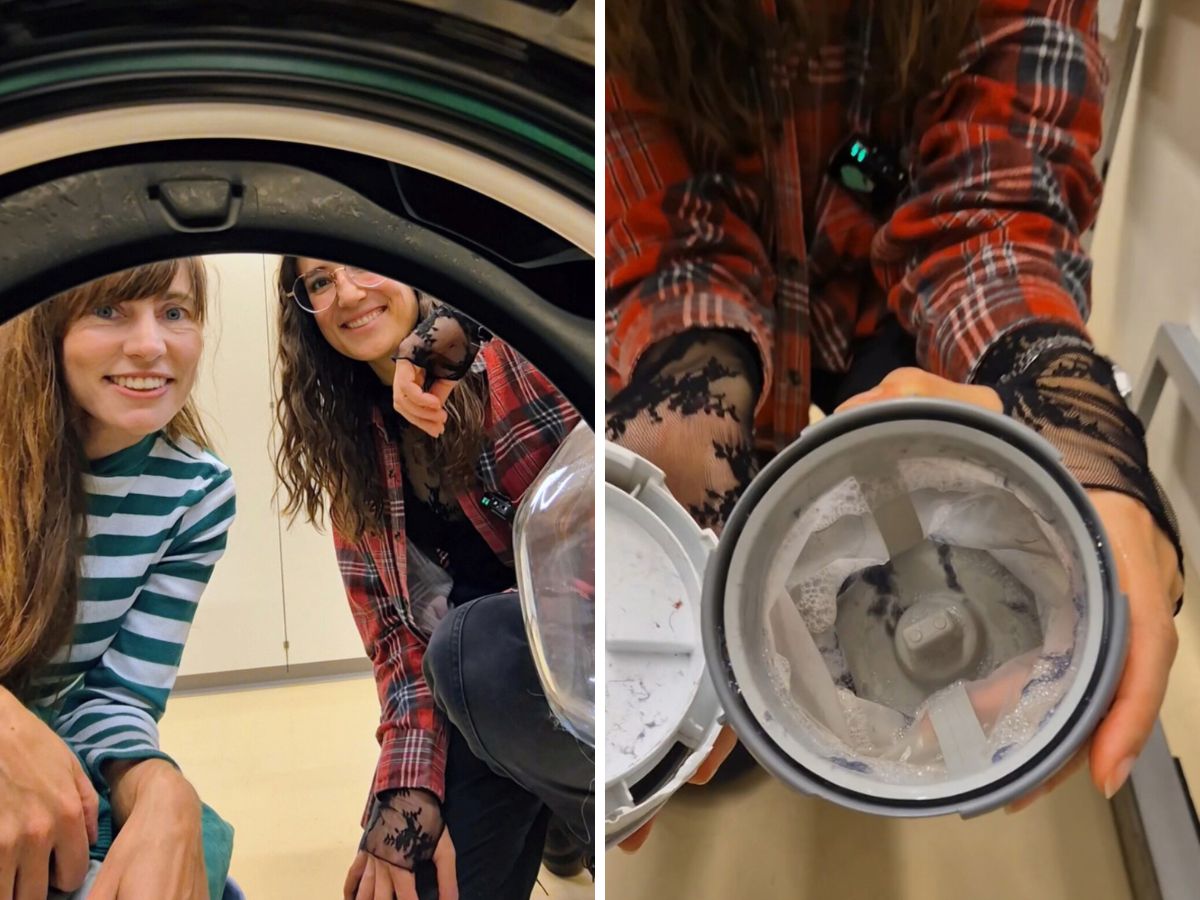
Through movement and friction, small flakes of fabric are released from your clothes. If the fabric is made of polyester or nylon, these flakes are made of plastic. During washing, they disappear with the wastewater into the sewer system and the water treatment plant. A large part of them is removed from the fabric, but not all of it. Some of the flakes still end up in surface water, in nature. To better understand what is released during a wash, the UvA is examining the laundry of ordinary households. Participants simply do their laundry, but have a special filter connected to their washing machine. The fibers collected are sent to the university for analysis. During our recording, the researchers were still actively searching for participants. Thanks to the publication of our video, the research was in full swing. How exciting that!
The washing machine is also running at the university. For example, researchers are testing whether it matters which detergent you use: powder, liquid detergent, washing-up cloths or tabs. Washing powder can cause more fiber loss due to its abrasive effect. The researchers are looking at how the different detergents interact with each other. Allison, who is involved in the research, also says that a full drum in previous experiments seemed to release fewer fibers than a full load of clothes. Possibly because the clothes rub against each other less. The research is still ongoing, so final conclusions have not yet been reached.
Buy less, choose better and wash less
The quality of your clothing also matters. More rigid synthetic fabrics can release fewer fibers than fabrics in which the fibers easily detach. The same conclusion was also reached by another scientist in our article about microplastics from your synthetic fluffy sweater. It is therefore about the material and how it is made, not just the brand name on the label.
The most practical approach starts with your wardrobe: buy less, choose clothes that last longer and only wash when necessary. It sounds so simple, we actually already knew this. A sweater doesn't automatically end up in the laundry basket after just one wear. You can also air it out or tackle a loose stain. Check out our tips to keep clothes clean without washing them.
In the video, Saskia goes to the UvA to pick up her dirty laundry to learn more about the research! And here you can find more about the research.