
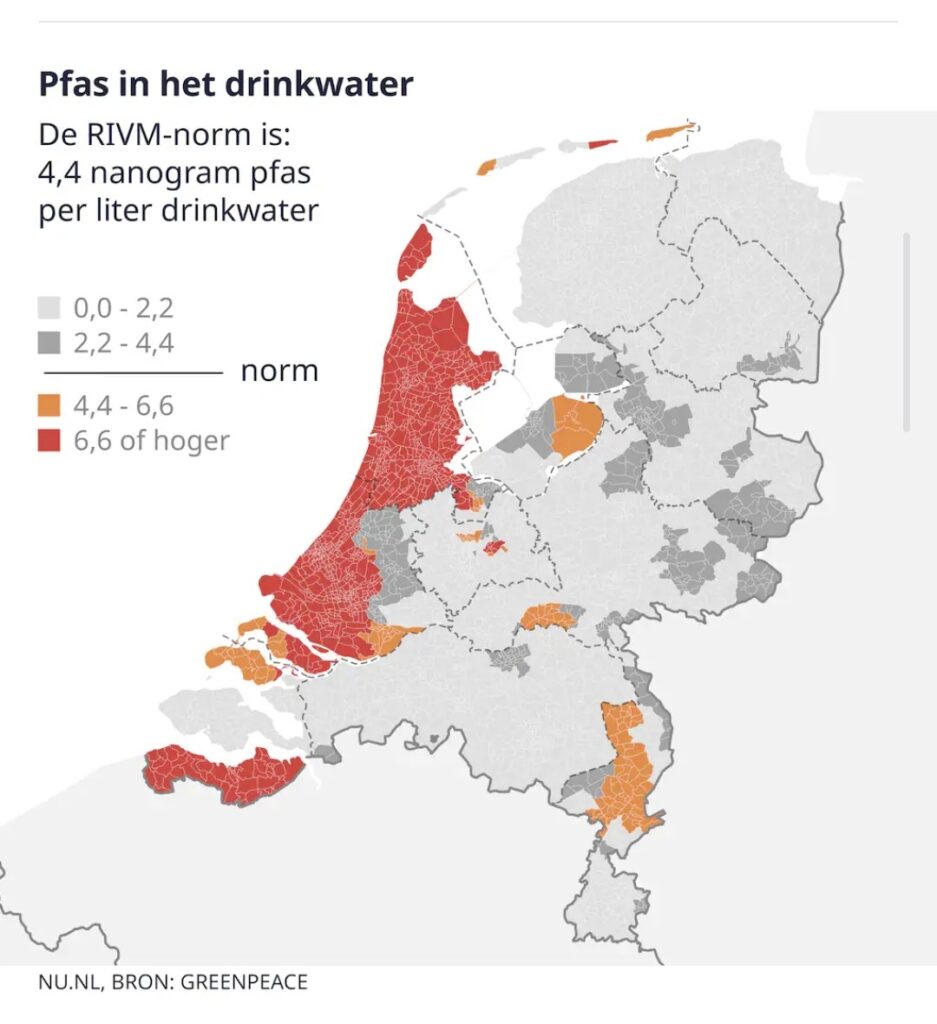
Do you live in the area around Amsterdam, Zaandam, IJmuiden, Alkmaar or Den Helder? Then this was the probably I was quite startled when I saw the red-colored map of the Netherlands. According to research by Greenpeace, there is more than two to three times as much PFAS in the tap water as the RIVM considers to be safe for your health. And even outside these regions, that value is exceeded. Yet the advice remains: continue to drink tap water. That requires explanation. Why does the amount of PFAS vary per region and what can you do yourself? With us headquarterss In the middle of the dark red area, we tried to figure it out. We also wanted to know: Why does it offer bottled water or a water filter no result?
PFAS in drinking water: what’s going on?
Back to that map. Greenpeace collected measurement data from the ten Dutch drinking water companies. It shows that more than a third of Dutch people receive tap water with more PFAS than the RIVM advises. Yet the Dutch drinking water meets the legal PFAS standard. Confusing? Two different measurement standards are used. The legal standard specifies how much PFAS is allowed in drinking water. The RIVM advises a lower amount based on knowledge about the health effects. In doing so, it takes into account the PFAS we also ingest through our food. The map therefore shows where the amount needs to be further reduced, not where you have to immediately turn off the tap.
What are PFAS and why are they a concern?
PFAS is a collective name for thousands of chemical substances created by humans. They absorb water, grease and dirt and are therefore used in, for example, non-stick cookware and raincoats. We have already written about PFAS in everyday products and even PFAS in vegetables and fruit. The tricky thing is that many of these substances hardly break down. Hence the nickname ‘forever chemicals’They spread through water, soil and air, and some accumulate in our bodies. With prolonged exposure, certain PFASs can reduce our immune system, damage the liver, increase cholesterol levels and affect reproduction. Some can also cause cancer. Not every PFAS is equally harmful: what you ingest, how much and for how long makes a difference. But that it is a mess is a given! The color on the Greenpeace card doesn’t show which individual PFASs were measured. That color summarizes the measurement results, taking into account differences in toxicity. Not that we find that very reassuring, but red means that the amount should be reduced, not that you automatically become ill from it.
Source: now.nl.
Why is there more PFAS in the drinking water in one region?
Those unlucky birds in Amsterdam and the northern part of North Holland have something in common: their drinking water is made up of a large part from surface water. For example, from the Lekkanaal and the IJsselmeer. PFAS can end up in these waters through discharges from factories, also from abroad. Drinking water companies purify that water, but removing PFAS completely is difficult. In Utrecht, drinking water is made from groundwater, which usually contains fewer PFAS. Deep groundwater may have fallen as rain hundreds to thousands of years ago, long before people started making PFAS. The water has slowly seeped down through the soil and is better protected by the overlying layers of soil against new contamination. That explains a large part of the differences on the map (but groundwater is not automatically PFAS-free either: pollution can eventually seep deeper into the soil. Even there, it unfortunately does not escape these substances completely).
Is bottled water a better choice when it comes to PFAS in drinking water?
With such a red card in your back pocket, a bottle of spring water from the supermarket suddenly sounds appealing. However, switching to bottled water does not guarantee that you will ingest less PFAS. The water in that bottle also comes from somewhere and can contain PFAS. Whether you ingest less of it depends on the source and the measured quantities. The label ‘spring water’ or ‘mineral water’ does not tell you that. In addition, there can be microplastics in bottled water (even in glass bottles!), as we already explained in our article about water bottles for your emergency kit. Moreover, all those bottles must be made, transported, and processed after use. Tap water is therefore a much more environmentally friendly choice. The advice therefore remains to drink tap water. However unsatisfying that may feel: by carrying around bottles, we are not solving the pollution of our water sources.
Is a water filter the solution for PFAS?
A water filter sounds appealing: tap water in, unwanted substances out. Still, filtering out PFAS isn’t that easy. Some filters can reduce certain PFAS, but how well that works depends on the type of filter, the substances in your water, and the maintenance. Moreover, you can get another problem for it: bacterial growth. And not just that, according to the researchers. When we have to believe the researchers. Pointer In 2024, tests conducted on tap water, spring water and water from a reverse osmosis filter showed that the filtered water contained fewer PFAS, but much more cultivable bacteria. Water researcher Roberta Hofman called that water therefore ‘absolutely unsuitable as drinking water’. That does not mean that every filter makes your water unsafe, but it does show that less PFAS does not automatically make drinking water better. Filters need to be properly cleaned and replaced in a timely manner; otherwise, bacteria can multiply in them. Due to those maintenance requirements and the varying effectiveness against PFAS, a water filter does not seem to be an easy solution for home use, which is also what some influencers are trying to sell you. Drinking water companies also claim that you do not need an additional water filter at home.
What can you do, then, against PFAS in drinking water?
Moving to the Utrecht Heuvelrug for a glass of water might seem a bit far-fetched. But it remains an unsatisfactory answer: there is little you can do to change the PFAS in your tap water. The advice is to continue drinking plenty of water and eating a varied diet. To put it in perspective: according to calculations by the RIVM, we receive on average in the Netherlands more than three times as much PFAS through food as through drinking water. This does not make the contamination of our tap water any less worrying. On the contrary: we receive these substances from various sources, and some of them can accumulate in our bodies. A cocktail of substances, in other words.
The problem is bigger than what comes out of your tap and now calls for action from politics and business. Measures are needed at the source: using and emitting less PFAS and stricter regulations for discharges. Furthermore, better water treatment is still needed. But as long as new PFAS end up in the environment, the faucet will continue to run open., pun intended. The Netherlands is working with four other countries on a European ban on PFAS. That also does not make our water clean overnight, because many PFAS hardly break down. Preventing the addition of new pollution is therefore urgently needed.
What can you do yourself? Well, not much. Except when buying new products, consciously choose products without PFAS, such as a PFAS-free rain jacket or PFAS-free pans. This helps to limit further spread, but the pollution that is already there will not disappear through our more conscious purchases. Unfortunately. In the meantime, just continue drinking tap water: that is still the advice, even if your postcode turns dark red.
Sources: Greenpeace, RIVM, RIVM, RIVM, Nutrition Centre, GGD Environmental Health, Waternet, Vitens, Vitens, PWN, PWN, Waternet, Pointer, EPA. Photo credits: Diana Dunayeva, Pexels.