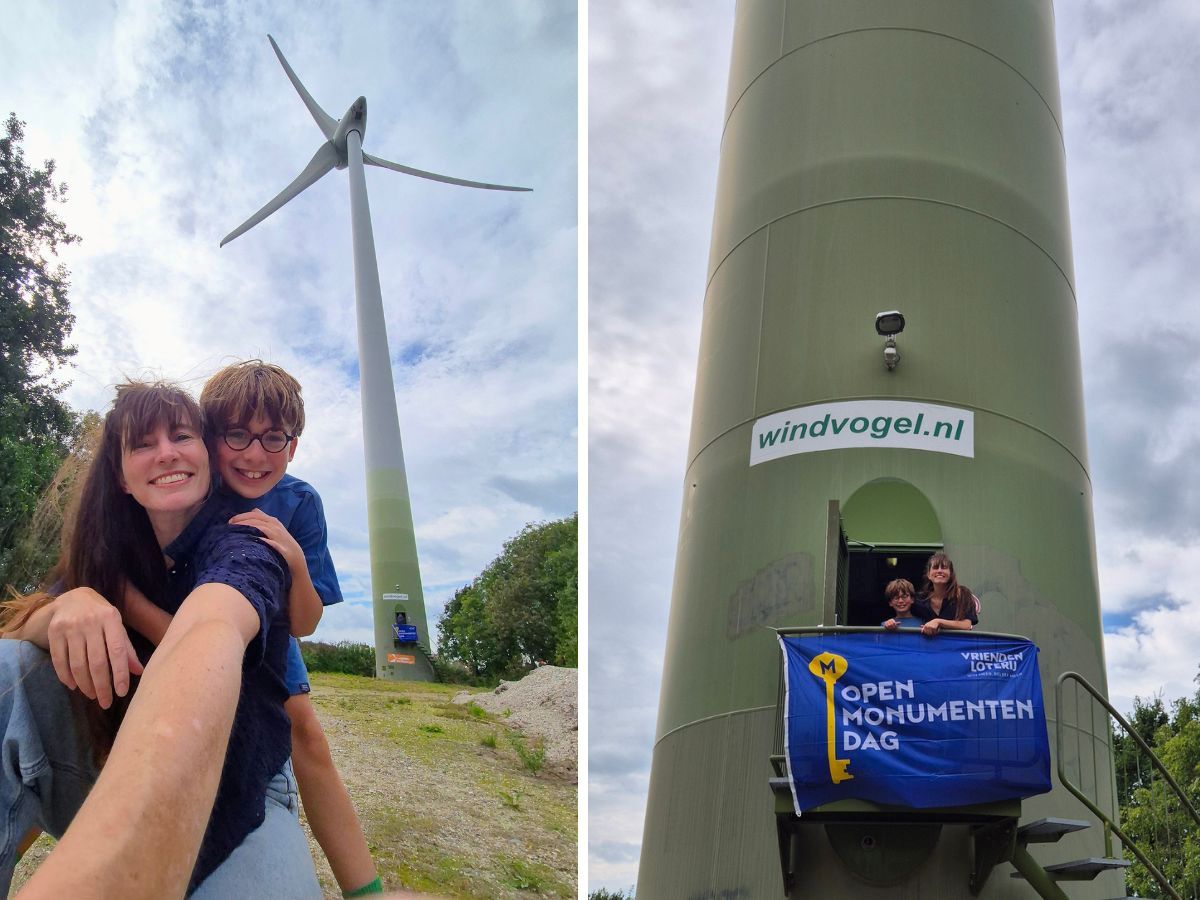

From the beach at the Ouderkerkerplas we always see her spinning: the Amstel Bird of energy cooperative De Windvogel. For years we’ve wanted to know what such a windmill looks like from the inside. During a tour with Erik, we finally got the chance to take a look inside and heard a lot of interesting facts about ‘our windmill’.
Inside the Amstelvogel by De Windvogel
The Amstel Bird is normally not open to visitors, but for Open Monumentendag the door opened exceptionally. Although the windmill is officially too young to be a monument, it is nevertheless a landmark building in Ouder-Amstel. A unique opportunity to finally take a look inside!
During a tour, we got to see how the windmill works and is controlled. As soon as you stand at the base of the windmill, you realize just how enormous such a structure is. The round steel tower rises straight up, with a very narrow and steep staircase leading to the technology at the top. Unfortunately, we weren’t allowed to go up. But when we saw how narrow the staircase is and heard that climbing is only allowed with safety equipment and according to strict safety regulations, we didn’t find that so bad anymore. Inside it was quite warm and the windmill made quite a lot of noise.
During the tour, we learned that the windmill has been located at Ouderkerkerplas since 2005. The windmill has a height of 85 meters and each beam is about 35 meters long. When a beam is upright, the highest point is therefore located at about 120 meters. From a distance, you can hardly see it. Only when you stand right underneath it do you see how gigantic those beams really are. And then that sound: woosh, woosh, woosh.
We were also able to view the current figures. At that moment, the wind speed was about 9.5 meters per second, comparable to wind force 5. So it was quite a strong wind. The sails rotated about 19 times per minute and the windmill produced about 1,500 kilowatts. That is 75% of the maximum power of 2,000 kilowatts. The wind speed, rotational speed, and output naturally change constantly, so these figures were a snapshot. On average, the Amstelvogel generates about 4 million kilowatt-hours of green electricity annually. That is enough electricity for about 1,300 households. At the beginning of 2025, the windmill also surpassed the milestone of 80 gigawatt hours of total output. Quite impressive for a windmill that has been running since 2005. For us, it was especially very nice to finally see what’s hidden inside the windmill that we often look at from the beach!
Curious to see what the Amstelvogel looks like from the inside? In the video, we’ll take you along on the tour.
You might also find this interesting
- Also see: A visit to Vrijopnaam, a truly green energy provider.
- Also see: shorter showers and more convenient water-saving hacks.
Photo credits: thegreenlist.nl.