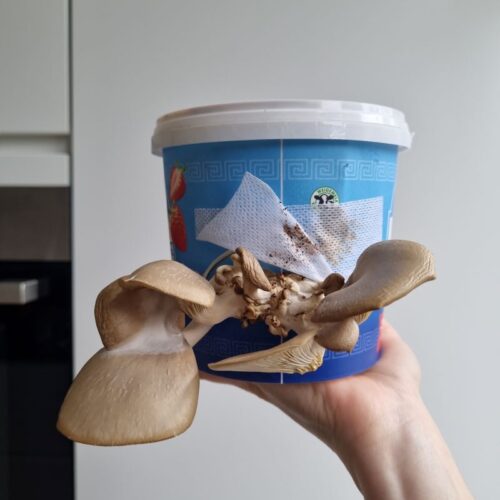
Grow your own oyster mushrooms with your homemade grow kit
After several very successful breeding rounds with the traditional grow kit (with bucket), I think it's a fun challenge to see if I can also grow oyster mushrooms in my own bucket. I get the oyster mushroom growing kit from Fryslân Fungies on the mat at home and I get to work as soon as my yoghurt bucket is empty. Handy: this cultivation set fits through the letterbox.
Kitchenware
- Oyster mushroom growing kit from Fryslân Fungies(I have breading for grey oyster mushrooms.)
- empty yoghurt bucket(Or another bucket that is not transparent, as oyster mushrooms grow towards the light.)
- kettle
- scissors or stanley knife
- 150g fresh coffee grounds or used filter coffee or Senseo pods
Instructions
Prepare breeding bucket
- Start on a day when you have a good load of fresh coffee grounds. Senseo pads and filters are also allowed in, the fungus eats it all.
- Wash the bucket thoroughly and, meanwhile, boil water in the kettle.
- Because you don't want to give other fungi a chance: rinse the inside of the bucket well with boiling water. This will make the environment sterile.
- Make 2 holes of about 1.5 cm diameter in the bucket. If your bucket is larger than 1.5 litres, make 4 holes. Make the holes with scissors or a Stanley knife. It's best to poke a hole first and then cut or slice it more easily.
- To be sure, I rinsed the inside of the bucket with boiling water afterwards, as I had touched the bucket in quite a few places again.
- Then tape the holes with the tape provided. Alternative: you can also use paint tape. Through these holes the oyster mushrooms get oxygen and later they will grow into this.
Grow kit preparation
- Wash your hands and loosen the grains of spawn in the bucket.
- Mix the spawn with 100 to 150 g of fresh coffee grounds.
- Moulds love moisture. You can recognise the right moisture content of the mixture by its dark brown chocolate-like colour. If necessary, add some water until it has the colour of dark chocolate. Tip: be careful when adding water, before you know it, it will leak out through those taped holes again. I had that, not smart.
- Put the lid on your bucket and let it rest at room temperature for a week.
- I understand your curiosity, but leave the bucket closed as much as possible. That way the environment remains sterile. If you still can't resist looking now and then, no disaster either. I did the same the first time out of curiosity and still got beautiful fungi.
Replenish, harvest & start again
- After a week (if all goes well), a down layer will have formed in the bucket. That is the time to add fresh coffee grounds again. Do this every week until the bucket is full. Tip: don't wait too long to top it up. Otherwise, the oyster mushroom may already start ‘fruiting’ in the bucket and you don't want that.
- After a few weeks (but I have also sometimes experienced that it took 3 months), oyster mushrooms emerge from the holes. They break through on their own, you don't need to do anything for this. Stay away from the tape! The oyster mushrooms will mature within 4-5 days and then dry out very quickly. Tip: keep the oyster mushrooms moist by misting them several times a day with the supplied spray bottle or a plant sprayer. And make sure to eat the oyster mushrooms immediately on day 4-6, when they are at their tastiest.
- Don't they come? Then you can lend a hand by misting the holes; they love moisture and daylight. Putting the pot outside in the cold overnight can also help (a tip only in the cold months).
- Have they hatched? Put some fresh coffee grounds in the bucket again (remove a layer with a spoon if necessary). Put new (painter's) tape on the holes and put the lid back on. You might just end up with a second (and maybe third) crop. Meanwhile, keep misting the taped holes!
- Don't they come back? Buy new spawn, clean the bucket and start again at step 1 (sterilise bucket).