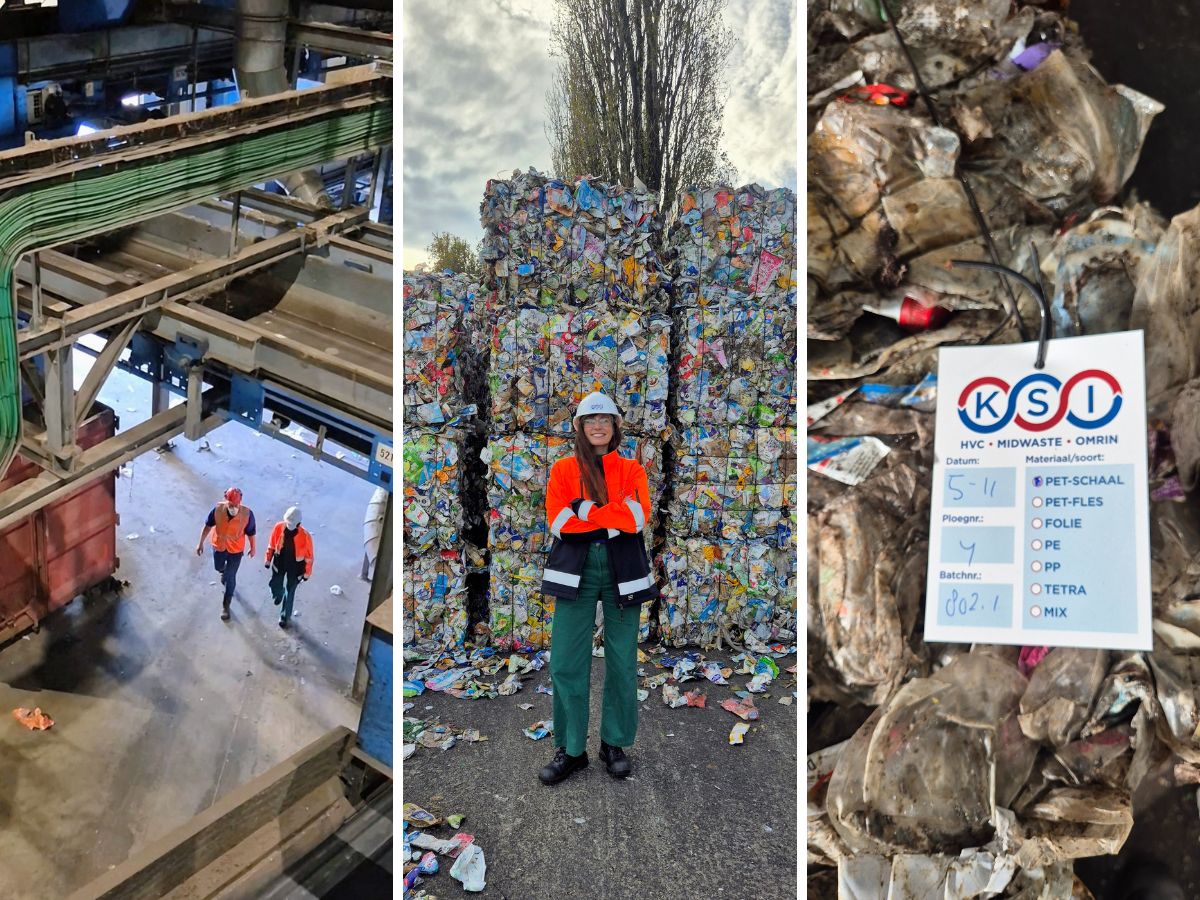

What happens to your empty soup can, carton of milk or the packaging of your veggie burger when you have obediently thrown it in the PMD bin or container? Saskia visited the KunststofSorteerInstallatie (KSI) in Heerenveen together with Spaarnelanden - the organisation that collects waste in Haarlem and Zandvoort. There, the PMD (plastic, metal and drink packaging) waste from millions of Dutch people is further separated and prepared for recycling. In total, there are nine different recycling streams. In many municipalities, such as Haarlem and Zandvoort, you still separate this waste at home. Do you do the same? Then you probably want to know why it is important to keep doing so properly.
From PMD waste to raw material
At KSI in Heerenveen This results in approximately 75 thousand tonnes of PMD waste annually. That's thousands of bin bags full of plastic packaging, metal cans, and drinks cartons, all of which still need to be further separated. Because this varied mix consists of no fewer than nine material types – and to recycle effectively, you first need to carefully sort them. The installations at KSI do this (almost) fully automatically – and quite cleverly – using trommel screens, wind sifters, magnets, and infrared scanners.
Did you know that in the Netherlands we produce on average around 450 kg of waste per person per year? Fortunately, PMD waste is doing quite well: over two thirds of it is now collected separately. At the end of the process at KSI, large compressed bales remain, each with its own raw material: PET (such as bottles and dishes), PE (hard plastics, such as milk bottles), PP (such as yoghurt and butter containers), foils, aluminium, steel (cans), drink cartons (also known as ‘tetra’), mixed plastics and non-reusable plastic. These bales then go to specialised processors who can make all kinds of things from them: new (food) packaging, fleece jumpers, tennis balls, garden chairs, car parts, roadside bollards, buckets, planters, pallets and even pipes for construction. From waste to valuable raw material, in other words.
What's actually in between?
To give you an idea of exactly what is then fished out of those containers - and what happens to it - we highlight four common containers for you:
- PET plastic packaging, such as a dish that has contained a veggie burger, belongs in the PMD bin or container. If properly separated, this material can even end up as new food packaging again.
- A juice or milk carton is a so-called beverage carton (also known as a ‘tetra’). It is made up of cardboard, plastic and aluminium. These layers are separated from each other and processed into, for example, egg cartons or toilet paper.
- A sturdy milk bottle or jerry can is often made of PE. After sorting, this plastic is reused in parts of household appliances, such as coffee makers or hoovers.
- Chip bags consist of several layers and are therefore more difficult to recycle. Nevertheless, in the right stream, they can still be processed into roadside piles or buckets.


In Heerenveen, PMD waste is separated even further, eventually resulting in nine separate recycling streams. Think PET by PET, drink cartons by drink cartons - this way, everything is neatly sorted and compacted into bales. On the face of it, it may still look like waste, but at that point it is actually ready for the next step: processing into new raw materials (see the last two photos). Left: a cassette tape, which does not belong in the PMD. The ribbons can get stuck in the installations and cause a lot of trouble.
Contamination in PMD waste
But yes... among all that well-meaning waste there is also stuff that really doesn't belong. About 25% of the PMD collected consists of things that are not packaging. Many people think: ‘It's plastic or metal, so chuck it in the PMD bin. Logical thinking, but unfortunately incorrect. Only packaging is allowed in: i.e. something that was meant to pack a product. So what kind of things do they come across at KSI that disrupt the recycling flow? Think toys, pan lids, Christmas lights, plastic garlands and garden hoses. The last three in particular are notorious. They get tangled up in the sorting system and cripple the whole system. And then there are the stray bicycle batteries, which can even cause a fire. And that, of course, is the very last thing you want if you are trying to separate your waste neatly.
Now you also understand why some municipalities - like Haarlem and Zandvoort - prefer to speak of PBD waste: that stands for plastic, cans and drinks packaging. Their reasoning? With ‘tin’, people think of packaging quicker than with the word ‘metal’. Tomato, tomato: it's just another name for exactly the same waste stream. And so it can be beautifully recycled!
Also important: empty packages as much as possible before throwing them away. A lick of yoghurt or a drop of sauce is really no problem. That will be rinsed clean later at the recycling plant. But big blobs or half leftovers? These make a mess in the machines and can seriously spoil the quality of the recycled plastic, cans or drink cartons. Our tip: scrape your packaging, but don't soak it under the tap. That again costs unnecessary water and energy.
PMD is not waste, it is a raw material!
The visit to KSI made one thing very clear: separating your PMD/PBD waste does make sense. Provided you do it right, of course - so only packaging, empty and loose in the bin. In municipalities like Haarlem and Zandvoort, you do it at home. But not everywhere in the Netherlands it is collected separately. This does not mean that it goes to waste: in those cases, the waste processor still extracts the valuable materials at a later stage. Anyway: when you see how much work and smart technology is behind making everything suitable for recycling again, you look at that empty milk carton or soup can with very different eyes, don't you?
More good waste tips
- Also see: glass recycling.
- Also see: From GFT to compost.
- Also see: The recycling of deposit cans, that's how!
Photo credits: thegreenlist.nl.