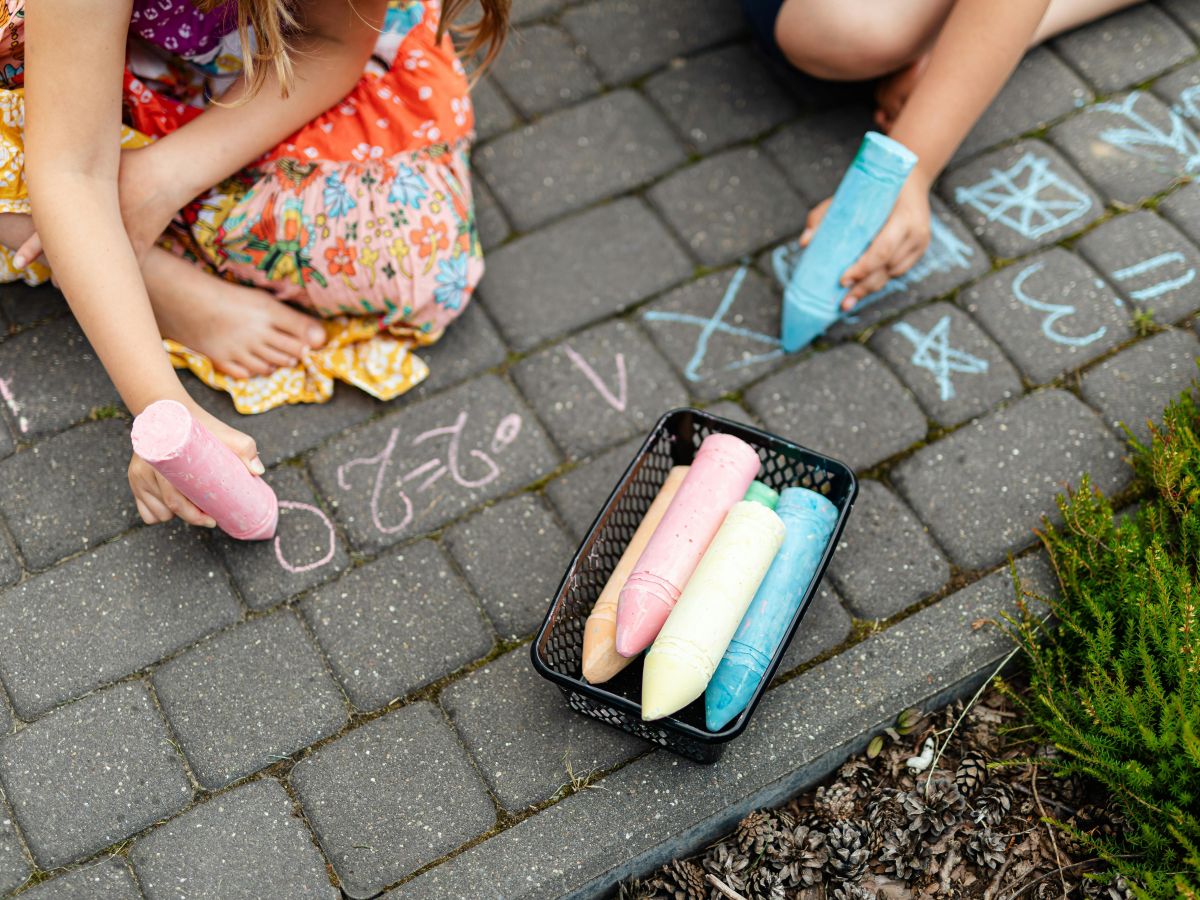

Which child doesn't love playing with pavement chalk these days? Grey tiles are transformed into the greatest works of art in all the colours of the rainbow. Meanwhile, the kids are happily playing outside, and after a shower of rain, everything is clean again. Pavement chalk therefore seems like ideal toy. But what is pavement chalk actually made of, and what washes into nature when it rains? We wanted to know all about this colourful chalk and went looking for eco-friendly chalk. Does such a thing exist?
Stoepkrijt is meestal gemaakt van gips en water, met toegevoegde kleurstoffen voor de kleur.
When children play with pavement chalk, you’ll not only see the street full of colour, but often the kids' hands, arms and clothes too. And when it then rains, all that cheerful chalk washes away into nature. That's why it's useful to know what pavement chalk is actually made of, so that it’s not harmful to health and the environment. Because pavement chalk falls under toys, manufacturers must comply with European safety regulations. However, they are not required to mention the ingredients on the packaging, as is the case with cosmetics or food. So, we did our own research.
We discovered that pavement chalk is mostly made from gypsum, also known as the natural mineral calcium sulfate. Calcium sulfate is also permitted as an additive in organic foods and therefore, in small quantities, is very unlikely to pose a danger to people or the environment. As gypsum is naturally white, colourants are added to pavement chalk. Unfortunately, these are not always very vibrant.
Toxic substances in pavement chalk
Colorants can be natural or synthetic, and with pavement chalk, it's often unclear which colorants are used. In 2016, German ÖKO-TEST Seventeen sets of chalk. In nearly two-thirds of the sets, they found colour pigments that can be carcinogenic, such as certain azo dyes which can release harmful aromatic amines. Oh dear! This was found particularly in red and sometimes also in brown and purple chalk. But there is also good news: in 2025, ÖKO-TEST re-examined seventeen sets and was pleasantly surprised that, this time, all the chalk was safe: no more carcinogenic substances or heavy metals were found. Heavy metals can be harmful to for example the nervous system or child development with prolonged exposure and also burden the ecosystem in large quantities.


It is good to know what pavement chalk is made of, as children get it on their skin and it ends up in nature.
Looking for eco-friendly pavement chalk
The problem usually lies with the colour pigments, which can be harmful to health and the environment. Unfortunately, the ingredients of pavement chalk are rarely listed on the packaging. A useful rule of thumb to help you choose: the brighter and especially more neon the colour, the greater the chance that synthetic dyes are present. This is because neon pigments cannot be made from natural materials.
Sustainable brands often mention that they use natural dyes, such as ecoNorm. Other brands that make more sustainable pavement chalk are neogrün and goki. These brands contain no harmful substances and are sustainably packaged in cardboard. If you want to be absolutely sure what's in your pavement chalk, you can also easily make it yourself.
Making eco-friendly pavement chalk yourself
Making pavement chalk yourself is not difficult at all, and you only need plaster of Paris and colouring. You can find enough recipes online. It is important that you use natural colourings, such as food colouring or Natural dye, chooses instead of acrylic paint. Acrylic paint contains plastic, and that's precisely what we don't want in nature.
How to find eco-friendly pavement chalk
The durability of pavement chalk therefore mainly depends on the ingredients, and particularly on the colour pigments. Unfortunately, these are usually not listed on the packaging. Most pavement chalk sold today is probably safe, but be cautious with old pavement chalk (from before 2016). Also check where the pavement chalk comes from and whether it has a CE mark. Note: there is also a ‘fake CE’, namely from Chinese webshops where it means ‘China Export’. Preferably buy pavement chalk from reliable Dutch shops and be careful with cheap varieties from outside the EU, such as via Chinese webshops, as these do not always comply with the same safety regulations. In this article, you can read how to recognise the genuine CE mark and check where something comes from. If you want to be absolutely sure what’s in your pavement chalk, you can also easily make it yourself.
You might also find this interesting
- Also popular with the kids: Are there sustainable balloons?
- Party time: how to organise a sustainable children's party?
- Great zero-waste craft tip: Making your own clay.
Sources: WHERE IS IT.nl, Ahealthylife.nl, USRA, IERE, ÖKO-TEST, TestReport.de, Smarticular. Photo credits: main image: Karola G (Pexels), chalk rainbow: Antonius Ferret (Pexels), child with chalk: Allan Mas (Pexels).