
What actually happens to your deposit can after you offer it into the deposit machine? We followed the entire journey of an emptied can to find out. We even crossed the border into Germany to see how can recycling works. Did you know that a can can return as new in just 60 days?
Why we recycle cans
In cooperation with Deposit Money Netherlands
Our soft drink cans are made of aluminium. And aluminium is mined from bauxite, a raw material that has to be extracted deep from the earth. To convert bauxite into pure aluminium, it has to be heated and processed under high pressure using large amounts of electricity. Not only the mining itself, but also this energy-intensive process requires huge amounts of water and emits greenhouse gases. As a result, the environmental cost of new aluminium production is extremely high. Fortunately, we can recycle aluminium endlessly without reducing its quality. Recycling still costs energy, but only a fraction of what it takes to extract new aluminium from bauxite. So, in short, by turning in empty cans and recycling them again, we not only save on raw materials, but also huge amounts of energy and CO2 emissions. So with every tin you return, we make a sustainable choice. So do it!
From deposit machine to new can: can recycling
After you return your empty can to the deposit machine, it embarks on a special journey to a second, third, fourth or maybe even eightieth life, because aluminium can be recycled endlessly without deterioration. And that makes it a special material that fits perfectly into a circular economy.


The collection and separation of deposit cans and PET bottles at the counting centre of Deposit Money Netherlands in Utrecht. Want to see more of that? Then watch the video report!
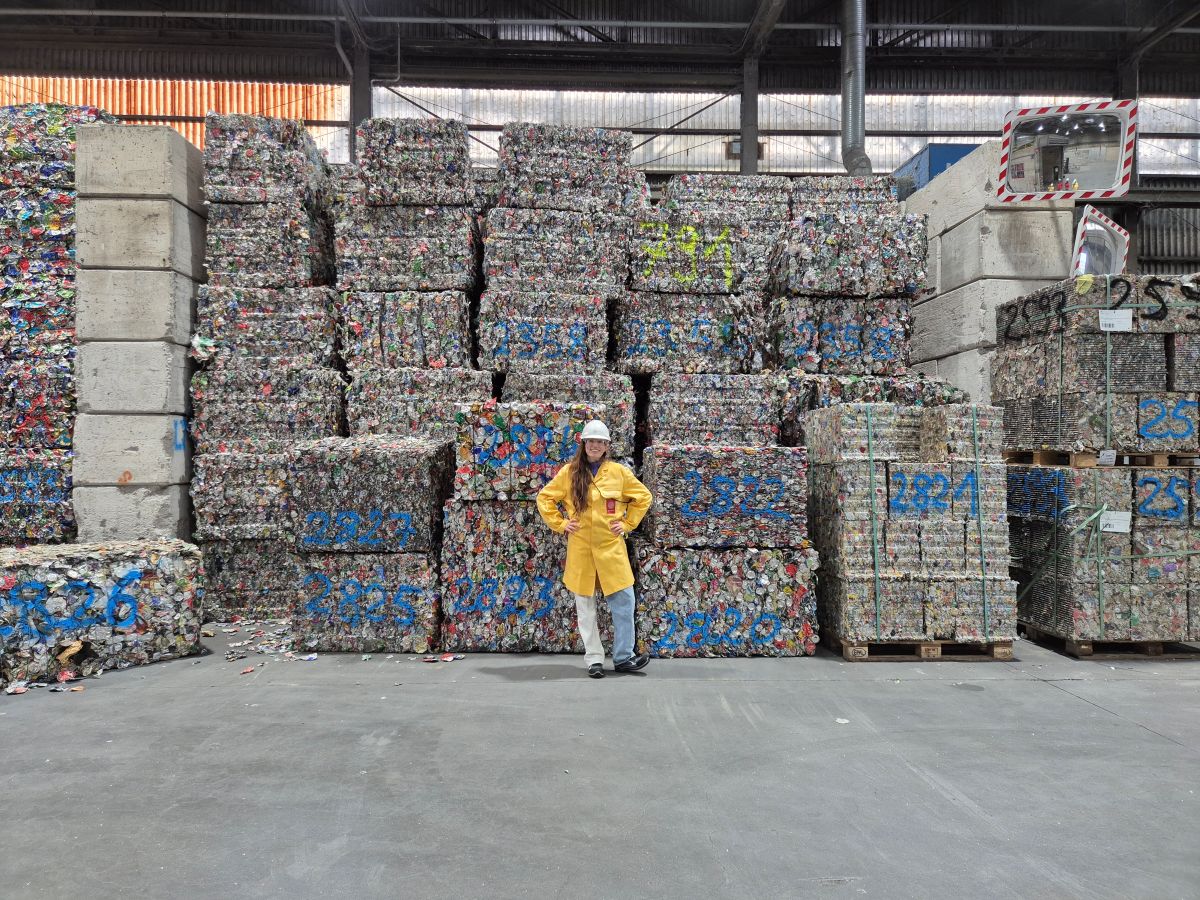
All returned deposit cans and bottles are transported in large bags to a counting centre. Deposits Netherlands has two counting centres, one in Utrecht and one in Tilburg, but the Netherlands has more counting centres because some large supermarkets take care of this themselves. So at the counting centre, cans and bottles still arrive together, where they are counted, sorted and separated via a conveyor belt. The cans and bottles are then compressed separately into large bales, each of which goes into its own recycling process. The bales with cans go on to the recycling centre in Neuss, which is just across the border in Germany, where the real recycling begins. The bales of compressed PET bottles go on to Zeewolde for their own recycling journey. You can read more about PET bottle recycling here.
Visiting a recycling plant for deposit cans
At the recycling plant, the bales - the compressed cans - are taken apart again and the loose cans go through a shredder to remove the last dirt and moisture. As an additional step in the process, an X-ray scanner is used. If anything is detected that is not aluminium, it is blown out of the batch with air pressure. This is important to keep the aluminium as pure as possible, because only then can you recycle it over and over again. Once the last of the dirt is removed, it is time for the next step in the process. This is the removal of the coloured coating, so that each can is the same silver colour again. This is done under a temperature of 500°C. Next, the uncoated cans are heated to around 730°C, which melts the aluminium. This liquid aluminium is then poured into large blocks. The aluminium is then ready for a new life. But it is not yet a can then...


Some of the steps in the aluminium recycling process: bringing in the bales of used deposit cans. Pulverising and cleaning the cans in the shredder with the aim that the aluminium goes into the furnace as pure as possible and, finally, melting aluminium. You can watch the video of the visit in Germany here!
Those aluminium blocks are rolled out into wafer-thin aluminium strips, these are thinner than a human hair. Compare this process to rolling out a ball of biscuit dough. Once rolled out, these long strips are rolled back into giant rolls - similar to giant rolls of wrapping paper. And those aluminium rolls are finally sold to can manufacturers who can make tin cans from those wafer-thin sheets. To give you an idea: one block of aluminium (see second photo below) can be rolled out into a 24-kilometre strip. At the can manufacturers, they get their new form as deposit cans in all shapes and sizes, from half-ounce beer cans to the tiny soft drink cans and everything in between.


Left: boilers with molten aliminium. Middle: blocks of recycled aluminium, almost ready to become another can! Right: a deposit can as we know it.
Final step: making cans
At Canpack in Helmond you can see exactly how it is done: there, the rolls of aluminium are cut to size and machines punch out countless small bowls from each piece, a bit like pressing biscuits out of dough with moulds. Those little shapes are then pulled out in several steps and made thinner and thinner, until eventually you are left with a cylindrical tin. The cans are trimmed (in the supermarket each can is exactly the same size), washed, dried and food-safe coated inside. Then they also get all the right branding from the manufacturer that ordered the cans, including a barcode and the deposit logo. Then the cans - still without lids - go on to the soft-drink producer. For example, at HEINEKEN's brewery in Zoeterwoude, cans are re-cleaned, filled quickly and fitted with an aluminium lid and expiry date. The cans then pass through pasteurisation - a process in which they are briefly heated and cooled to make the drink last longer. And your can is ready! Back on the shelf. Or in your picnic bag. Ready for a party. And hopefully... soon back on the road for yet another round of recycling.


Left: the process at Canpack, centre: cans prepared at Canpack (including branding!) to be filled at the various (soft) drink manufacturers. Want to see more of this process? Then watch the video report at Canpack. Right: filling deposit cans at HEINEKEN's brewery. We also made a video of this.
Recycling cans: here's what you can do!
Do you want to contribute to a smooth recycling process? Then collect your empty cans neatly and return them without dents and without waste. Damaged cans are sometimes not recognised by the deposit machines and waste residue can even interfere with recycling. So, with a little care, you will not only help the planet, but give your can the chance to be shiny new again on the shelf within sixty days, ready for another round! Tips to better collect deposits at home we also have for you.
Photo credits: thegreenlist.nl.