
A subject you probably prefer to avoid with a bow: your own farewell. Yet it is valuable to pause and reflect on this. Because longevity does not end with life. By sharing your wishes in time, you give your loved ones something to hold on to and avoid making difficult choices during an emotional time. That farewell can also be more sustainable. We sat down with DELA to find out how you can make a funeral greener - from coffin to funeral transport and more.
A final green greeting
In cooperation with DELA
What do you think about when you think about a more sustainable funeral? Or maybe you prefer not to think about it at all and avoid the subject. Hup, on with the order of the day. Recognisable... Yet it is valuable to take a moment to think about this. So that's what we're now doing together with DELA. After all, there are surprisingly many more environmentally friendly choices to be made. You often think you are being more sustainable if you opt for a simple coffin or a modest bouquet. But there is so much more. From an electric hearse to a burial board and even eco-friendly funeral cards. But first the key question: burial or cremation?
Which is more sustainable: burial or cremation?
One of the first choices is: will it be burial or cremation? Traditional burial is more damaging to the planet than, say, electric cremation. Then again, I can also imagine that you like the idea of burial better. What then? Even if you choose burial, you can make a difference by making slightly different choices and recording them in a last wishes document so that your next of kin can organise it for you. For example, an unpainted wooden coffin, a wicker basket or a burial board made of natural materials is less harmful to the environment than a traditionally manufactured coffin. And also, a natural grave monument, such as a boulder, is a more sustainable choice than a traditional headstone made of natural stone, such as granite or marble.
A headstone... or something else?
So choosing a headstone has an impact on the environment. Many headstones are made of granite - a natural stone that takes millions of years to form. After clearing the grave, such a stone often ends up as rubble. And does the granite come from abroad? Then transport causes extra CO2 emissions. The most sustainable choice right now? No stone. But if that doesn't feel right, there are nice alternatives such as a small tree or shrub, a wooden keepsake or a Dutch boulder.


A natural cemetery and an organic urn made from different types of organic clay.
Nature cemetery?
In our brief, contrived brainstorming about more sustainable funerals, the first thing we thought of was the natural cemetery. But what exactly does that entail? We asked DELA. ‘A natural cemetery is a resting place in the middle of nature, such as a forest or estate, where graves merge into the landscape. There are currently 41 such cemeteries in the Netherlands. Many people choose these because they find it a nice thought to literally return to nature after death. Instead of headstones, there are subtle markings, such as a wooden disk, a boulder or GPS coordinates. Special rules also apply: coffins, burial boards, urns and clothing must be fully degradable and synthetic fabrics such as nylon are not allowed.’
Important to know: the degree of sustainability of natural cemeteries is viewed and discussed from different angles.
Coffin, basket or burial board?
What do we do with the coffin? Or wait, is a coffin even necessary? You guessed it, there are several more sustainable choices here too. Coffins or burial boards made of fast-growing, domestic wood such as poplar, willow or Norway spruce are a good choice, if they are FSC-certified and produced without chemical varnish, glue or metal. A bier board with a shroud is slightly more durable than a coffin because it requires less wood. The shroud, a large cloth in which the deceased is wrapped, can be made of natural materials such as raw cotton.
And there are also woven caskets. Such a funeral basket is made of braided reeds or other plant stems such as willow twigs. Advantage: no tree has to be cut down for it. Often, funeral baskets and palliatives are woven from organic cultivation. You can also make more sustainable choices for the upholstery. Beware though, a basket is not accepted by all crematoria. You read it: here too there are so many different, and therefore better, choices. Immerse yourself in them and decide which options you prefer.
Mushroom chest?
An interesting invention is the Loop Living Cocoon, also called the mushroom chest. This coffin is not made, it grows and that takes only seven days. The box is made of mycelium, the root network of fungi, and breaks down completely in the soil in about 45 days. You feed nature and become one with nature again. A nice thought, I think.
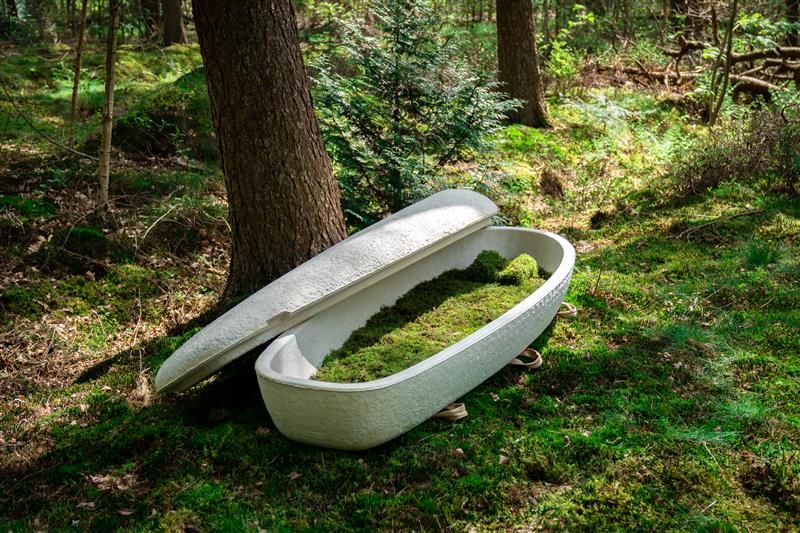
Walk Living Cocoon, the mushroom box that breaks down completely in 45 days.
Cardboard box?
OK, what about a cardboard box? That also sounds sustainable. As with any material, there are pros and cons here, we learn from DELA. Cardboard naturally breaks down pretty quickly in nature. But it shouldn't get wet, so a funeral in the rain is tricky. Also, burial is not possible in a cardboard coffin; you can only use the coffin on the day itself. And not every crematorium accepts cardboard coffins either. In short, a cardboard coffin is a nice sustainable idea, but in practice perhaps not the best option (especially in the rather rainy Netherlands).
Funeral printing: paper or digital?
Funeral cards are a valuable gesture for many - something tangible, something personal. Want to send these? Then the tip: choose eco-friendly paper and ink and record this wish as well. In addition, you can ask yourself: should it be sent by post? A digital card is faster, saves paper and transport, and always arrives on time. Especially if you know that many people read their invitations on their phones, digital is definitely an option to consider. Of course, a digital bereavement card is not yet common, so if that's what you would like: commit to it!
Making a difference with (mourning) transport
When you think of a funeral, your first thought is the kilometres a hearse has to travel, but the actual kilometres (and thus emissions) are much higher. Especially visitor transport - all those cars to and from the location - leaves a considerable ecological footprint. If you want to make a difference to this with your last greeting, put down that you want to be taken to your final resting place by electric transport. More and more funeral directors are offering electric hearse services. This is not only more environmentally friendly, but also more pleasant during the funeral procession - you are not standing in the exhaust fumes and the ride is quieter and quieter.
You can also record something about how you want your guests to come to your funeral. As much as possible by public transport or by bike? Or maybe you want to put on your funeral card that guests prefer to come to your funeral together. Every little bit helps. DELA: ‘Or choose a less obvious option such as a walking carriage. With a walking carriage, the deceased is accompanied on foot. This is not only sustainable, but also personal and peaceful. Especially for short distances, a walking carriage can be appropriate: a last walk as a moment of farewell’.
One last piece of advice from DELA: keep the locations close together. By planning the funeral home, crematorium and coffee table or drinks in one place or close by, you again limit kilometres. You can also record this in advance or give it to your next of kin so they can take this into account when organising your farewell.
Flowers: beautiful, but not always sustainable
Flowers are part of a funeral, but they also affect the environment - especially when flowers are flown in. And to think that a lot of flowers are thrown away immediately after a funeral. This can also be done differently, such as a flower band with loose Dutch flowers from the open ground, artificial flowers you can rent, or asking all guests to bring one flower themselves.


Flowers at a funeral are very personal. Many people have specific wishes about them. These wishes can also be more sustainable by recording, for example, that you want loose flowers instead of flower arrangements, or flowers from the season (if possible). Photo credit coffin: Levroi Media.
A more sustainable farewell: the overall picture counts
In short, a more sustainable funeral is not about one choice, but about the whole. And that starts with awareness. Lay down your wishes - not only for yourself, but especially for the people left behind. They want to get it right. And you can help them by making clear what you think is important. For example, use a sustainable funeral checklist or a wish book. This way, you make the farewell personal and reduce your ecological footprint.
Photo credits: DELA, other: mushroom box: Loop Biotech, box with loose flowers (last photo): Levroi Media.