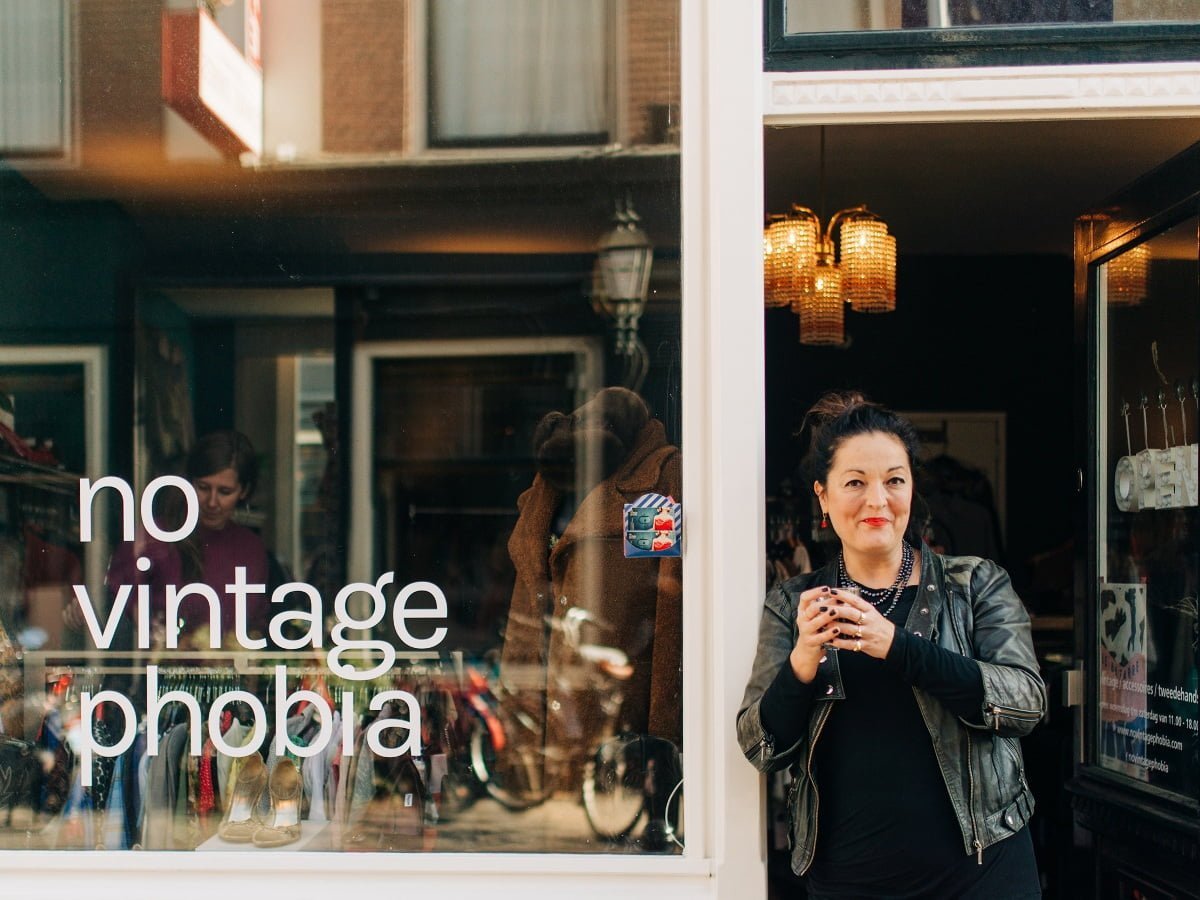

Clothing has become a disposable product: we buy it too much and discard it too soon. Every year, we buy an average of 50 newly made garments per person, each of which has a huge negative impact on our planet and people. We have known for some time that there is also a lot wrong in the clothing industry. A shame, agrees Anabelle Noordewier, owner of the boutique No Vintage Phobia, in a side street of Vredenburg in Utrecht. How can it be different, we wonder? Anabelle knows.
No Vintage Phobia: buying and selling unusual second-hand clothes
Vintage, preloved, second-hand, so many names for pretty much the same thing: clothes that have been worn before. With vintage, the line is around the 1980s and everything after that can safely be called preloved or second-hand. Anabelle's shop is full of both. They are all garments that did not end up on the destruction circuit, but have been given one, two or so more lives. And that is a huge environmental gain, because imagine if every Dutch person bought six fewer garments, we would save 85 thousand road trips around the world, says Milieu Centraal. Can you imagine if you buy all your new clothes second-hand! We should opt more for quality rather than quantity, Anabelle believes. ‘Shopping is like a hobby for many people. I really think buying new stuff is a waste of your time and money. So many beautiful items have already been produced, shop second-hand.’


Second-hand boutique No Vintage Phobia sells second-hand and vintage clothes for men and women in Utrecht. And the book Niks Nieuws (by thegreenlist.nl) is also on sale here!
How do you actually recognise quality second-hand clothes?
‘An item of clothing that is ten years or even 40 years old that you can still put on is by definition of better quality. Clothes used to be really better made than now: what you buy in shops now breaks down quite quickly, especially fast fashion. At my place hangs a mix of vintage and second-hand from the nineties and noughties. All brands that make or made quality clothes. A nice Irish wool jumper will just last at least ten years. The quality is better, so the pieces are just still good. The selection is purely by feel. Of course, I look at how the item looks; I check everything carefully. You won't find items with missing buttons, lint and a washed-out look. I get so many offers that I am in a bit of a luxury position: I can pick out the best treasures. Of course, this is only good, because what is hanging in the shop then is of good quality. Nor do I take on fast fashion brands. Once in a while if a lady brings in a bag full of top pieces, I don't bother. Better a second-hand Zara than a new one right?’
With vintage, you might also think of rather fierce floral prints, but we don't see those hanging at No Vintage Phobia?
True! Vintage can also be classic: woollen jumpers, good jeans, nice leather belts, silk scarves. Seventies floral dresses and Hawaii blouses can also be found in other shops that specialise more in the seventies. My pieces are timeless. There are still so many items that are decades old and still beautiful. It would really be a shame to do nothing with them and make new clothes.’
You can also buy clothes at the thrift shop. What's different about No Vintage Phobia?
‘I love thrift shops! But you have to have the time to go through a lot of clothes to just pick out the nicest items, and there is quite a lot of fast fashion that is quickly broken. For me, the preselection is already done, so ladies only have to look for their style and size. I am very critical. There are no doubt cases hanging among them, everything is hit and miss and sells. I have learned to say no to clothing entries that just really don't fit the shop.’
So when we buy clothes from you and other places second-hand, we save super much environmental suffering. And what to do with the clothes hanging in the closet that we don't wear?
‘You can give those away, take them to the thrift store or if you have really nice pieces, bring them to a shop like mine. There are also many boutiques in other cities that work on the consignment principle: you hand in the clothes, I sell them for you and then you get a share of the proceeds, with me it's 40 per cent. My contributors are often also my shoppers, so that's doubly sustainable. Selling yourself on Vinted is also possible, but that is a lot of work and there people want it for a very low price and it can take a long time before your item is sold. After all, there's so much out there. With me, all you have to do is turn it in!’
Where does your love of second-hand actually come from?
‘From my grandmother I think. She had a bric-a-brac shop. It was full of antiques: magical, I thought. She used to go to auctions to treasure hunt. Then she brought branded clothes to our house that came out of suitcases that came from lost property departments. I really love second-hand. Those rush When you score a treasure for little! Wonderful, I don't need any more drugs.’
What are your tips for people who don't buy second-hand yet because they think they can't find anything or think it's difficult?
Set yourself up for not finding too many items at once when second-hand shopping. If you already find one nice item, that's already great! Build your wardrobe slowly. If you buy nice items they will last a long time, so don't be in a hurry. Ask for help in the shop if it is too much and you can't see the wood for the trees. The people in the shop know exactly what's hanging. I think we have really started down the path of sustainability. Second-hand is becoming more and more normal.’
Lots of colours, prints, full racks and in the corners boxes full of promises of new clothes that no one has seen yet. But then so not new. Rather loved or yet not favourite. Treasure seekers in the shop not only make themselves happy, but also Mother Earth. Anabelle's shop can be found at Willemstraat 57 in Utrecht. You can follow No Vintage Phobia via Instagram.
More sustainable tips from thegreenlist.nl
- Got hungry after all that shopping? One of our favourite sustainable restaurants in Utrecht is Le Jardin. Recently, they also opened a sandwich shop: Pain du Jardin.
- Also at Bunk you can enjoy delicious sustainable food and sleep in Utrecht.
- Looking for outdoor clothing? This Beverwinkel in Utrecht is all about recycling.
Photo credits main image: Libia Arteaga, other: Juri Hiensch (portrait two) & thegreenlist.nl.