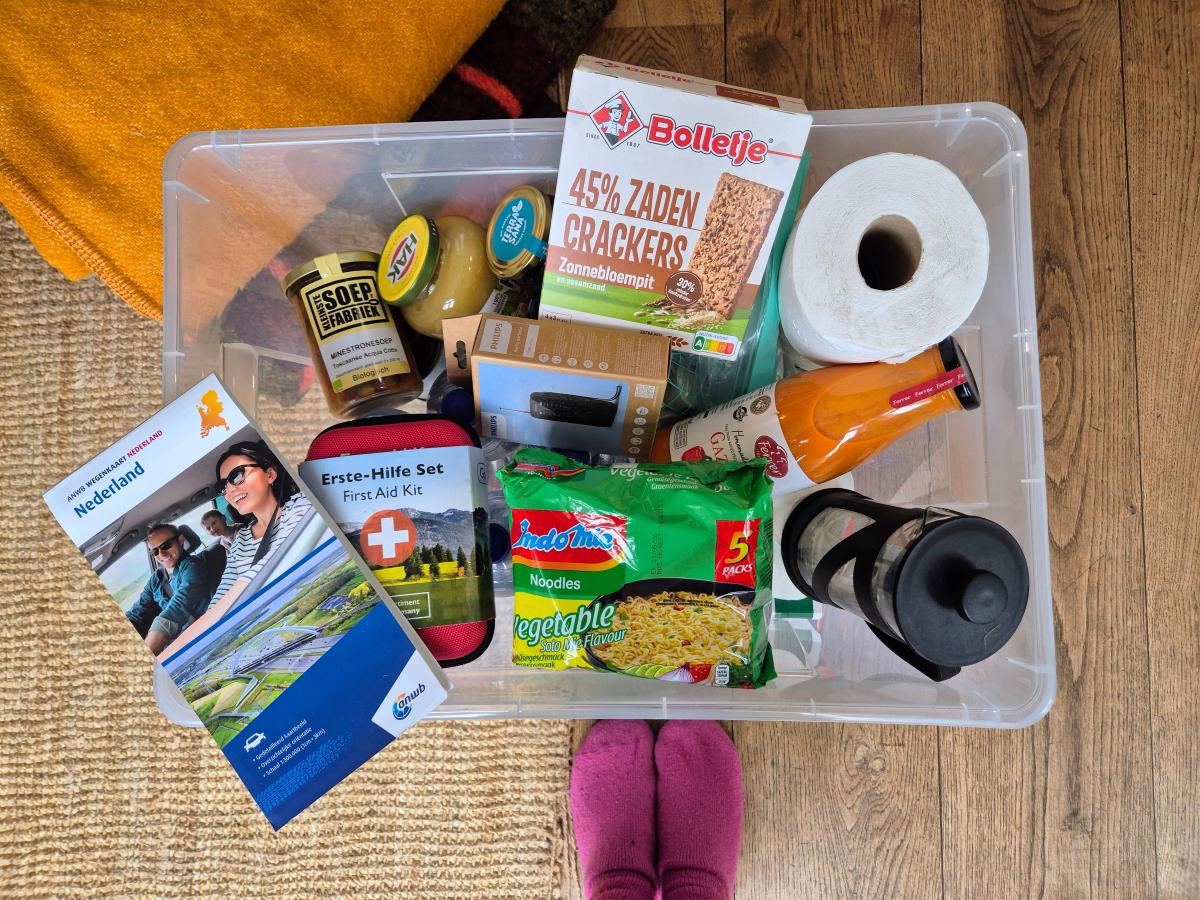

That was a bit of a gulp when the booklet ‘Prepare for an emergency’ fell on the mat. A national call to make an emergency kit and an emergency plan for when the power goes out, the water no longer comes out of the tap or you have to temporarily leave your house. And so Saskia, like many, bravely set to work. Because yes, you hope it will never be necessary, but a little preparation can't hurt. So we thought: can it be a bit sustainable? We dove in, scoured our own cupboards and asked our followers for their smartest tips. The result: a realistic and greener emergency kit you can start using right away. Good luck! Or should we say strength?
What's in an emergency kit?
As far as we are concerned, an emergency kit should above all be good, practical and adequate. No endless wrangling about whether something is sustainable enough is - in a crisis situation, you just want to be able to rely on what you have. Think nutritious food, clean drinking water, light and warmth. But still, we started looking: are there choices that are both smart and perhaps just a touch more sustainable than the standard options? We took the government's list, dived into our closets and asked our followers for help. And surprisingly smart tips came up. We take you through them all.
Making an emergency kit more sustainable
It is quite complicated to prepare for something you have hopefully never experienced before and never will want experience. Moreover, the scenarios are SO different. If you suffer a long power cut in summer, you can stay at home, empty the fridge and freezer and maybe even light the barbecue. But if a flood threatens, you will have to flee and those heavy cans of beans will be of little use. Our conclusion: there is no such thing as one perfect emergency kit. And yes, waste and overconsumption (because hopefully never needed) lurk. Still, there are some smart choices to make that are handy in many situations ánd that we can look at with sustainable glasses. These are our tips.
Tips for putting together your emergency kit
Putting together an emergency kit is quite a chore. You get a booklet from the government with explanations and a shopping list, but then? The smart thing to do first is to see what you already have in the house. Open your pantry and collect food that has a long shelf life. Don't be immediately put off by the THT date - that stands for ‘best before’ and mainly means that the taste and quality may deteriorate after that date. Many products will keep for months, sometimes even years or indefinitely. You can read more about the THT date in this article.
Start with what you already have
Chances are you can already cross out quite a few. Think canned food and other preserves, such as beans, soup, crisps, crackers, a jar of peanut butter, nuts, tinned fruit or snacks. Also keep in mind that you might not be able to reheat some things. So make sure you get food that you can also eat cold. Tip from a follower: note in your diary when your emergency ration is (almost) past its expiry date, so you can eat it in time and replace it. But again: that THT date is not a tight deadline.
Need to replenish your food supply? Then choose organic or fair trade products whenever possible. They keep just as long and are better for people and the environment. Think of fairtrade peanut butter, fairtrade canned fruit and organic preserves and nuts. In this way, you can make your emergency stocks just that little bit more sustainable without putting in a lot of extra effort.


When putting together your emergency kit, think above all about food that is nutritious, has a long shelf life and can also be eaten cold. Make a more sustainable choice by supplementing it with organic and/or fair trade products.
Which water do you choose?
A sustainable option might seem like: filling water bottles yourself. But that is not the most hygienic solution for long-term storage. This is because bacteria can build up if your bottles are not properly clean or if the water stands still for too long. What does seem to be a smart and safe choice: glass bottles of spring water from the supermarket. These are well-sealed, have a long shelf life and you can simply refill them for home use after use. So you have a reliable and reusable supply of water in your emergency kit. But... bad news for those who think drinks from glass bottles contain less microplastic. A recent French study shows just the opposite: drinks in glass were regularly found to contain more microplastic particles than the same drink in plastic bottles or cans. The culprit is not the glass itself, but the metal caps - especially the coloured paint layer on the inside. That layer wears off through transport and storage, releasing particles into the drink. Plastic bottles usually have caps without such a paint coating, which makes this particular risk somewhat smaller. Still, even these can release microplastics over time, especially when exposed to heat. Do you opt for plastic anyway? Then use it mainly as a temporary solution and keep it cool and dark.
In this article, you can read more about which water is best to choose for your emergency kit.
Source: Medscape
Then we've come to non-food. Again, you probably already have more in the house than you think: tea lights, matches, batteries, tools, blankets, a torch or maybe even a power bank. And oh yes, a toothbrush, toothpaste, toilet paper, disinfectant gel, sanitary towels, tampons and your medicines shouldn't be missing either, of course. No blankets in the house? Check the thrift store! You can often find very nice vintage woollen blankets there for next to nothing. And if you have a powerbank: charge it immediately and check regularly if it is still full. Handy reminder: do that at the same time as checking your emergency stock.
Smart additions to this we also got from our followers. Like a small camping kit that still allows you to heat something - think a gas burner or spirit stove. And what if your water no longer comes from the tap? Then a water filter like the LifeStraw handy to have around the house. With these, you can safely drink rain or ditch water, for example. This is also handy if there is an emergency situation where you have to flee or move around, because then you don't have to lug around all those bottles.
Another tip from a follower: candles can be dangerous, especially with children. Rechargeable LED lights are a lot safer and you can safely leave them on out of sight. Tip from us: you can often find these in thrift shops too! And it's not on the official list, but trash bags are also a must. This way you can dispose of used toilet paper neatly when the toilet no longer flushes. Nice and fresh. Coffee addict? You are not the only one. A simple percolator or coffee filter holder (you can often find them for next to nothing at the charity shop) ensures you can make a decent cup of coffee even without electricity. We thank this follower for this tip!
Replenishing your sustainable emergency kit
What you are still missing, put on a list. Think of a map of the Netherlands or your municipality, a First aid kit with whistle, radio, torch or - good tip from a follower - Decathlon's Lumen rechargeable dynamo which you can also charge by hand. Extra batteries or that power bank may also be on it. Do you have a battery-operated radio? Set it to the right frequency now and put a sticker on it with the channel - saves searching when it comes to it (another smart follower tip). And if you add a first aid kit: put a basic booklet with first aid instructions. Just assume you won't have access to YouTube tutorials during an emergency.


Tip from a follower: already set the radio to the right frequency for your region and put the frequency on the radio as well.
Take care of it yourself
Finally, there are a few things you need to arrange yourself, such as a list of phone numbers, a copy of your ID card. Tip from a follower: make a colour copy of the front and back, plasticise it and put it in your emergency bag. And arrange cash: the guideline is 70 euros per adult and 30 euros per child. Have you collected everything? Then your basic kit is complete. The idea behind an emergency kit is that you can grab it quickly and be on your way immediately, should the need arise. But with a few litre bottles of water added, it soon becomes plumb heavy. A tip we also got: divide the stuff between one or two backpacks. (No backpack? Check the thrift store!) Or store them in a sturdy backpack. Also these handy shopping bag from Ikea was tipped. You can carry those on your back as well as over the shoulder.
The complete packing list for your emergency kit can be found here.
Also very important: make an emergency plan and discuss it
A well-stocked bag is one thing, but also make arrangements with each other. What do you do if a real emergency arises? Where do you meet, how do you keep in touch and what do you do if someone is not at home? Also think about (vulnerable) family members or neighbours: who checks in with whom? Especially if you have children, it is important that they know what to do. Suppose they are at school, playing outside or at the sports club - what then? We agreed with our 10-year-old: you follow the instructions of the adults or the leaders. And if you are sent home and we are not there? Then he knows which neighbour to turn to. Such agreements require little effort but really make a difference in the moment.
More tips from thegreenlist.nl
- Also see: cooking with leftovers.
- Also see: Learn the intricacies of passive cooking.
- Also see: Shorter showers and other shower hacks.
Photo credits: thegreenlist.nl.