
Did you know that behind those colourful garments in your closet there is an average water consumption of 640,742 litres? A bizarre amount! This is according to research by life cycle assessment expert Green Story in collaboration with Epson. In fact, this puts the Dutch in sixth place in Europe. And yet we often only hear about the environmental impact of the material itself - such as cotton, which requires a huge amount of water. But there is another big culprit that is often forgotten: textile dyeing. And let that be exactly the part where Epson offers a pioneering alternative with their industrial textile printer - the Monna Lisa ML-13000.
Dyeing fabrics with a textile printer: how does it work?
In cooperation with Epson
Dyeing textiles the traditional way is a polluting process. It consumes huge amounts of water and often involves the use of substances that are harmful to nature and health. Especially in production countries where working conditions are not always safe, this poses serious health risks for the people working with these substances. Fortunately, things can be done differently. At Epson, they show that you can make fabrics print instead of traditional dyeing. We took a look at Epson Netherlands and saw how their Monna Lisa printer works. A promising innovation that could contribute greatly to making the fashion world more sustainable!
How does Epson's Monna Lisa textile printer work?
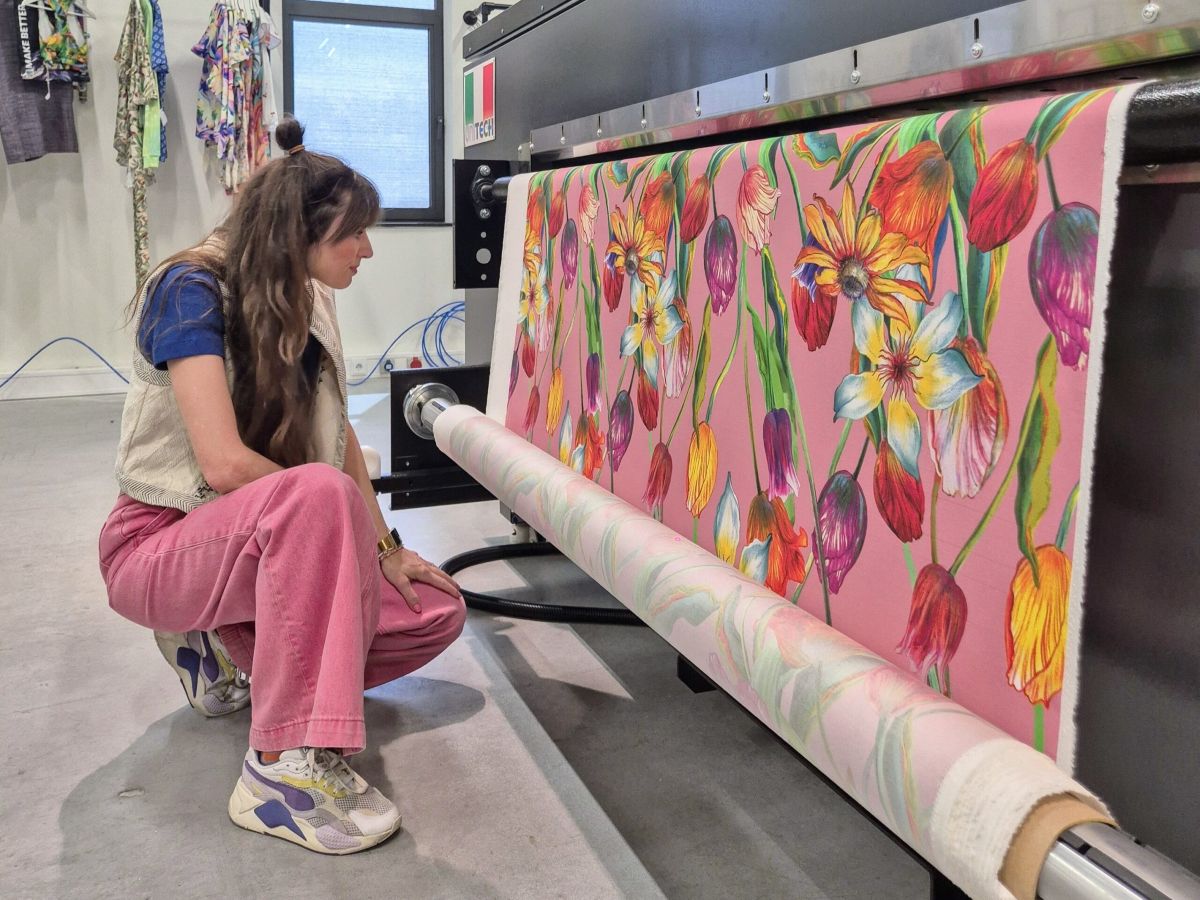
The Monna Lisa uses a digital printing process where a design is printed directly onto the fabric. No dye baths, no rinse water and hardly any waste. As a result, up to 97% less water is needed than with traditional dyeing techniques. And the best part is: designers can design and print their own fabrics. No standard patterns or large print runs, but customisation. This allows them to match exactly what they need, which prevents waste and gives room for creativity. Your own print, your style, without environmental damage - that sounds like the future of fashion, doesn't it? We think so!


Designer Marylene Madou designs her own botanical fabrics by hand, which she then digitises and has printed on fabric by Epson's Monna Lisa ML-13000 textile printer. Marylene was one of the participants of the Epson Design Awards 2023.
From research data to fashion with a mission
To show what this technology makes possible, Epson also collaborated with design studio Patternity. Together, they developed a collection of four beautiful scarves: the Epson River Silks. Each design is inspired by a European fashion capital: Paris, Milan, London and Amsterdam. The scarves are made of Eco Satin, a blend of 65% Lenzing™ ECOVERO™ and 35% silk. That sounds luxurious - and it is - but with a green edge. Cool! That's because ECOVERO is a viscose fibre sourced from sustainably managed forests. And its production takes up to 50% less water and CO2 than regular viscose. Yep, even the material is well thought out. The result? Four dainty, soft and super-stylish scarves that tell a story. In short, a real fashion statement!
Are you a designer or a company that works with textiles and would like to view this Monna Lisa ML-13000 printer? You can visit us in Ede at Nauta Textile Solutions.
Sources: The Epson water footprint report.