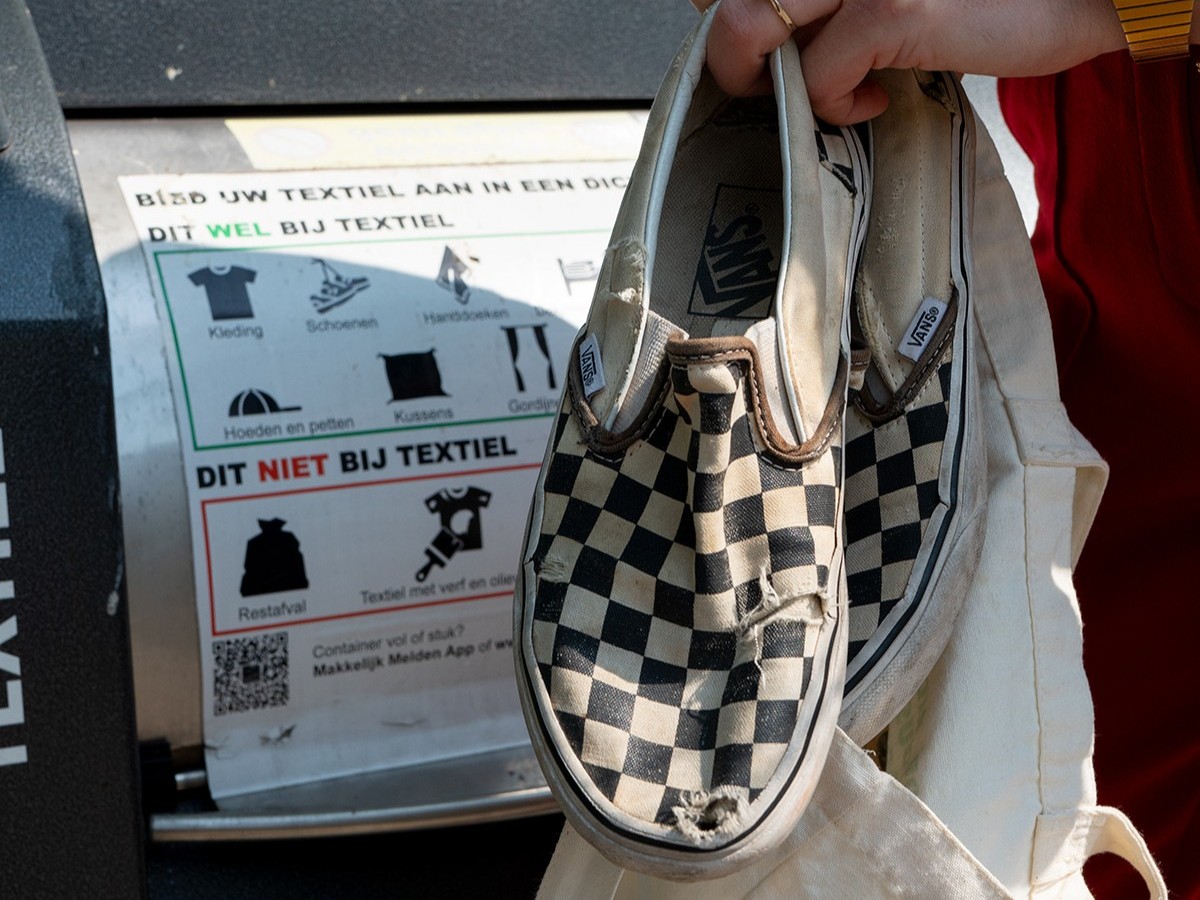

It is a tricky dilemma and a question we get very often from readers and followers: should you use the textile container or not? The short answer is: yes. But... with a caveat. Because all the second-hand clothes you donate - via textile bins, for example - have become trade. Trade that travels halfway around the world. And that is, to put it mildly, not so good for the environment. In this article, we explain how it works, so that you can make a better assessment of what you do and do not put in.
Why the textile container is also a good idea
The idea behind the textile container is not so crazy, because textile recycling can and must improve. At the moment, we throw away clothes en masse in the wrong way: more than half of all discarded textiles end up in residual waste and end up in the incinerator. Such a shame, because according to CBS, at least 58% of these clothes could still have been worn or recycled.
That is why it is nice that there are places where you can hand in textiles separately. Sorting centres estimate that some 90% of the textiles collected get a second life. Preferably as clothing, of course, i.e. reuse. But what is really no longer wearable can be perfectly recycled into something ‘lower-value’ such as insulation material, acoustic padding, cleaning rags or the stuffing of car seats. So for old textiles, the container is definitely a better option than the dustbin. And you can put more in it than you might think: towels, tea towels, scarves, cuddly toys, curtains and shoes - though please tied in pairs or in a bag - are also welcome. The technology is there, the bin is often around the corner - so what do we care?
But - and that ‘but’ is coming - that is not the whole story. Because while the system is technically sound, there is also a considerable downside to this seemingly circular route. And it starts as soon as you realise that the clothes you turn in do not simply end up at a charity, but rather become part of a global trade.
Used clothing's global journey is polluting
What many people don't know: clothes you hand in a textile container rarely just stay in the Netherlands. Most collected clothes are sold to sorting companies, and from there traded to international buyers. Large batches go in bulk to countries like the United Arab Emirates, where they are temporarily stored in so-called ‘free trade zones’. They then travel on to places like Pakistan, where the clothes are sorted by hand under poor working conditions - read: nice and cheap. What is saleable sometimes - after thousands of kilometres - returns to Europe as vintage. The rest ends up on markets in Africa or still in landfills.
Textile containers marked with a charity are also usually part of this system. The clothes do not go directly to people in need, but are sold to sorting centres. The proceeds are then used to fund new projects. And although these projects are often very useful and much needed, it is good to be aware of the real purpose of collection: not necessarily to help people by donating clothes, but to generate income for charities.
According to research by Follow the Money, the CO2 emissions of a garment triple when it is sent abroad for sorting and sale. If it goes by plane, emissions are even 12 times higher than if it were processed locally. And not everything makes it to the finish line: clothes get damaged, are not saleable or still end up as waste. That makes the whole chain - which was once meant to be recycled - pretty sour.
Project CeCe also underlines this picture: many clothes are traded rather than directly reused. Vintage shops often buy up in bulk what has previously been sorted in Pakistan. And so those ‘vintage finds’ are nowhere near as authentic or sustainable as they seem. Have you always wondered why some vintage shops have such perfectly curated collections? Then now you have your answer. Those clothes have often been collected all over the world, filtered out for style and marketability and then imported back. The worst clothes often end up in Africa, where the quality is so low that they can't do much with them. After many detours, it still ends up there in the now iconic garment mountains in Ghana and Chile, among others, which can even be seen from space. Unfortunately, that vintage oma stocking in that charming boutique is often a less authentic find than it seems.
VIEW ALSO: how to recognise illegal textile containers?
To use or not to use that textile bin?
We are regularly asked whether we would recommend a textile bin. Our honest answer: yes, for broken textiles that can be recycled, the textile container is currently the best system. So mainly throw it in there - better than in the residual waste, because then it disappears into the incinerator. But for good clothes and textiles that can easily last another round? Then we prefer another destination. Hand it in at a charity shop, sell it through a platform such as Vinted Or give it away through an initiative such as The Clothing Loop (a clothing exchange network). At least then you can be sure that your clothes will stay here, and not travel halfway around the world to end up in a clothing dump after all.
More articles you will find interesting
- Also see: toxic fast fashion clothing.
- Also see: Sell your old books online and make money.
- Also see: glass recycling, that's how it works!
Sources: Follow the Money, EenVandaag, Radar, Milieu Centraal, CBS.nl, rtlnews.nl. Photo credits: Angela de Vlaming.