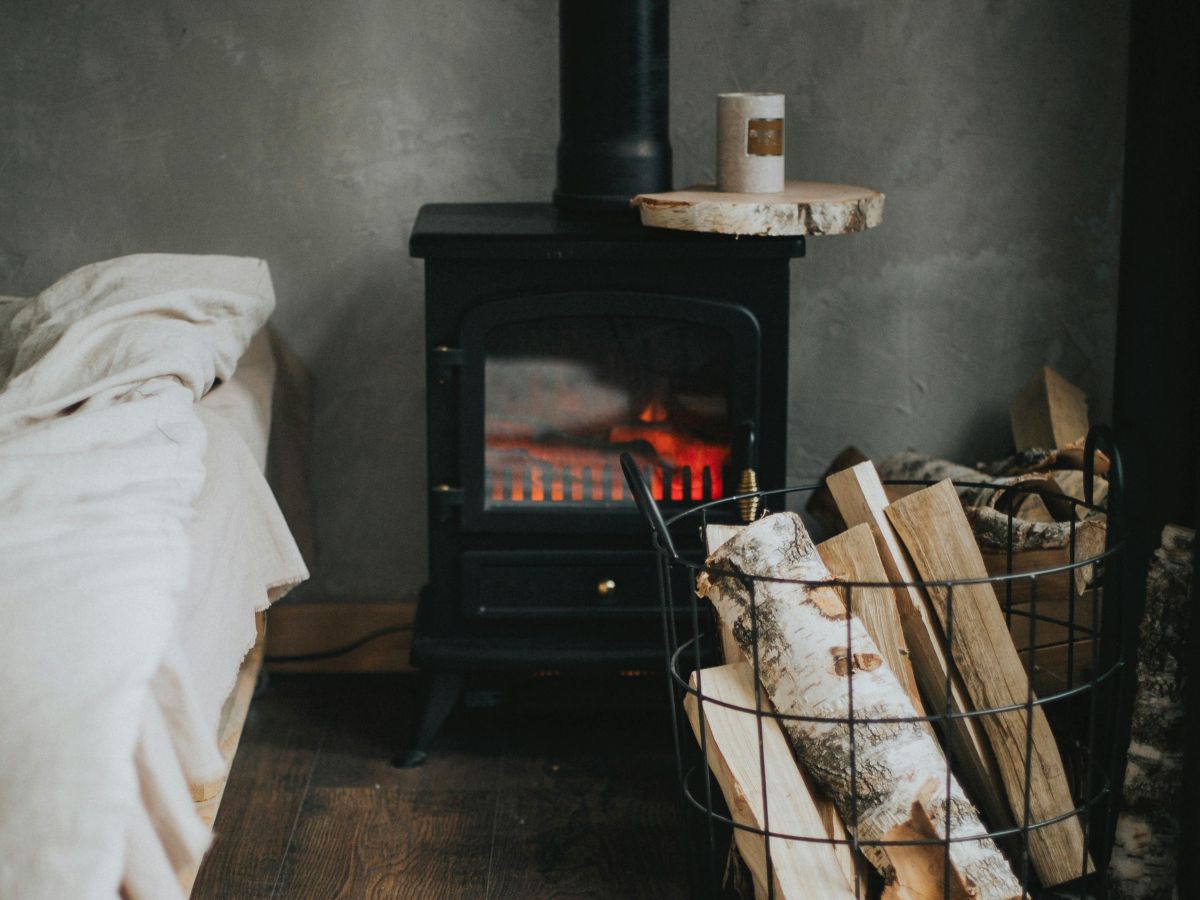

Sitting by the fireplace during a cold winter evening or a fire in the garden on a summer evening, it feels cosy. We thought so too. Until we delved into what wood burning actually does to the environment and to our health. Whether it is a wood-burning stove, an open fireplace or an outdoor fire basket: burning wood releases a lot of CO2 and particulate matter. This causes extra emissions and polluted air, which is anything but good for the environment. Besides: you inhale that smoke yourself, just like your neighbours. That suddenly makes it a lot less cosy. So can you still fire responsibly? Thegreenlist.nl looked it up for you.
Burning wood for heating, sounds quite sustainable
Burning wood feels like a green choice to many people. This is because wood is considered renewable energy in Europe and counts towards sustainability goals. In fact, biomass, which includes wood, is the largest source of renewable energy in the EU. No wonder, then, that a wood-burning stove or fire is often seen as a responsible option. Yet in recent years there has been increasing criticism from environmental and health organisations. After all, how green is wood burning really? Burning wood often turns out to be less sustainable than it seems, and it can also have serious consequences for our health.
The environmental impact of wood-burning stoves and fires
When wood is burned, it releases CO2: you know, that greenhouse gas that causes climate change. Proponents of wood burning say it is CO2-neutral because the tree removes CO2 from the air during its lifetime. What they often forget to mention is that at least as many trees have to grow back as are cut down. That takes time. It is important that the wood comes from responsibly managed forests, where biodiversity is preserved and at least as much wood grows back as is cut down. Unfortunately, this is not the case for much wood that is fired. Finally, the CO2 needed to cut, process and transport the wood must also be factored in.
In the past, when there were fewer of us and wood was mainly used locally, a fire was perfectly manageable. Now that we fire wood en masse, indoors and outdoors, it is no longer so. For heating your home, there are simply better options these days. A central heating boiler or heat pump converts energy into heat much more efficiently. With a wood-burning stove or fireplace, much of the heat disappears immediately through the chimney. With a wood-burning stove, about 35% is lost, with an open fireplace even the vast majority. Per quantity of heat supplied, wood-burning causes relatively high emissions and air pollution.
Outside, basically the same principle applies. A firebasket or garden fireplace feels cosy, but produces little heat and, on the contrary, a lot of smoke and fine dust. If you want to sit outside longer on a chilly summer evening, an extra jumper, a blanket, a heat lamp or infrared pillow or electric blanket - you have such good solutions these days like from Stoov, Fatboy and even just at Hema - often better and cleaner.
Our conclusion: the CO2 once absorbed by trees simply does not outweigh the emissions and pollution caused by wood burning. And that particulate matter is not only damaging to the environment, but also to your health.
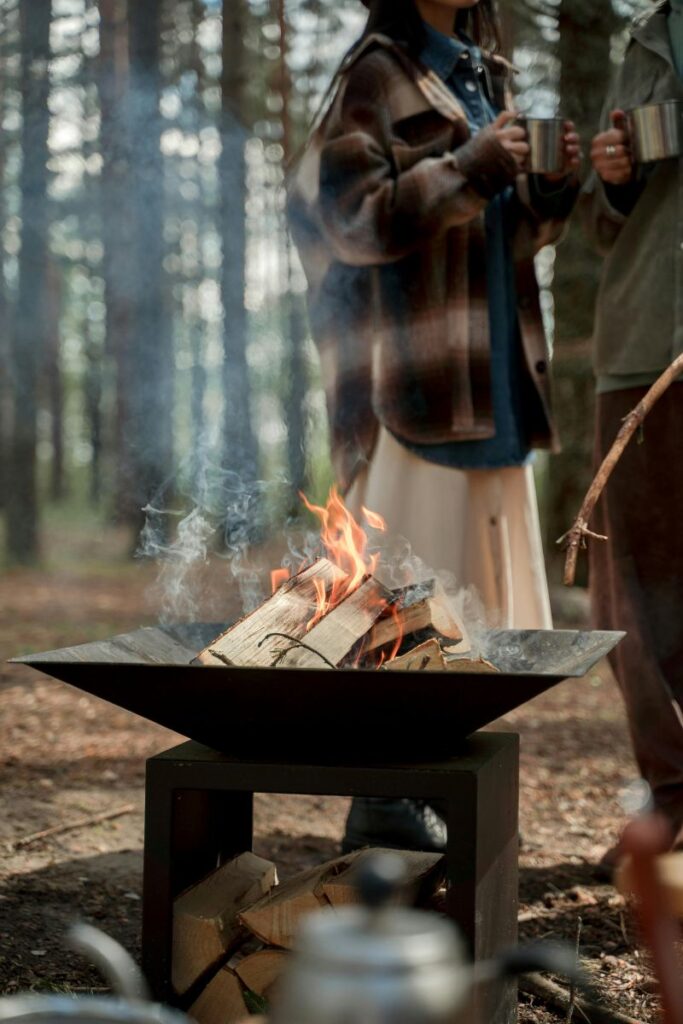
Lighting a fire in summer is cosy, but unfortunately not so good for the environment and public health.
The impact of a wood stove or fire on health
So while stoking a wood stove or fire, particulate matter is released. Fine dust can have different sizes. The fine dust released during wood burning is usually very small. To be precise, often smaller than 2.5 micrometres, which is why it is also called PM2.5 (Particulate Matter). These tiny particles can penetrate deep into your lungs. Ai, that doesn't sound so nice. Exposure to particulate matter can cause or worsen various lung diseases and cardiovascular problems. Milieu Centraal has calculated that an average of 28 grams of particulate matter is released during a four-hour evening stoking - that's a small weck jar full! And this not only comes out of the chimney, but some also ends up in your living room.
Even if you don't have a wood-burning stove, you can be bothered by your neighbours' stoves. As much as 23% of PM2.5 fine dust emissions in the Netherlands are caused by wood-burning stoves and fireplaces. That is four times more than what road traffic emits! And particulate matter is not the only thing released while burning wood. Carcinogenic PAHs, volatile organic compounds (VOCs) and carbon monoxide are released into the air.
Ban on wood burning
We are not the only ones to realise that wood burning is bad for the environment and health. More and more municipalities are introducing rules about lighting wood stoves. In Amersfoort and Eindhoven, for instance, it is forbidden to light wood indoors if the Heating guide code red or orange. In Zoeterwoude, you are not allowed to fire wood indoors at code red. In Voorst and Venray, there is a ban on burning wood in foggy and windless weather. And they are currently going furthest in Utrecht: there, it is already prohibited to burn wood outdoors and in 2030, the city wants to ban wood burning altogether.
Source: Lung Fund.
This is how you heat more sustainably
Do you have an indoor or outdoor wood-burning stove and still like to turn it on from time to time? Then there are a few points you can pay attention to in order to make it a little less harmful to the environment, your health and that of your neighbours:
- Do not fire in foggy or windless weather. Check the Heating guide Whether it's a good time to light the stove or better to wait a little longer.
- Light the stove at a time when there are as few people outside as possible. Your neighbours will thank you.
- Choose clean, untreated and dry wood. For the self-sufficient among us, freshly cut wood needs to dry for at least two years before you can use it to light the stove.
- Make sure the stove gets enough air when you light it. If necessary, open a window.
- Make sure your chimney is well maintained and have it swept annually.
Is a wood-burning stove or fire out of date?
Taking an honest look at the harmful effects of wood stoves on the environment and our health, we come to the conclusion that wood stoves are actually out of the question. If you already have a wood stove, you can at least try to use it as sustainably as possible and light it at the right time. We don't think buying a new wood stove is a good idea. Rather heat your home - or yourself - with one of the other options. Big fan of infrared pillows and electric blankets here! Still want the cosy atmosphere of a crackling fireplace in your home? Then there are other ways to do so. For instance, play a fireplace movie on the TV or choose an electric stove that looks like a wood-burning stove. They are so well made these days that you can hardly tell the difference.
You might also find this interesting
- What about fireworks? And is there such a thing as sustainable fireworks?
- Even light affects our environment. How does light pollution affect nature?
- The stuff you have in your home can also be harmful to your health. Do you have toxic items in your home without realising it?
Sources: Milieu Centraal, Lung Fund, Pointer, RIVM, Ecobuilders, European Commission, European Lung Foundation, Tagesschau. Photo credits: main image: Kasia Palitava, Pexels, other: Ron Lach, Pexels.