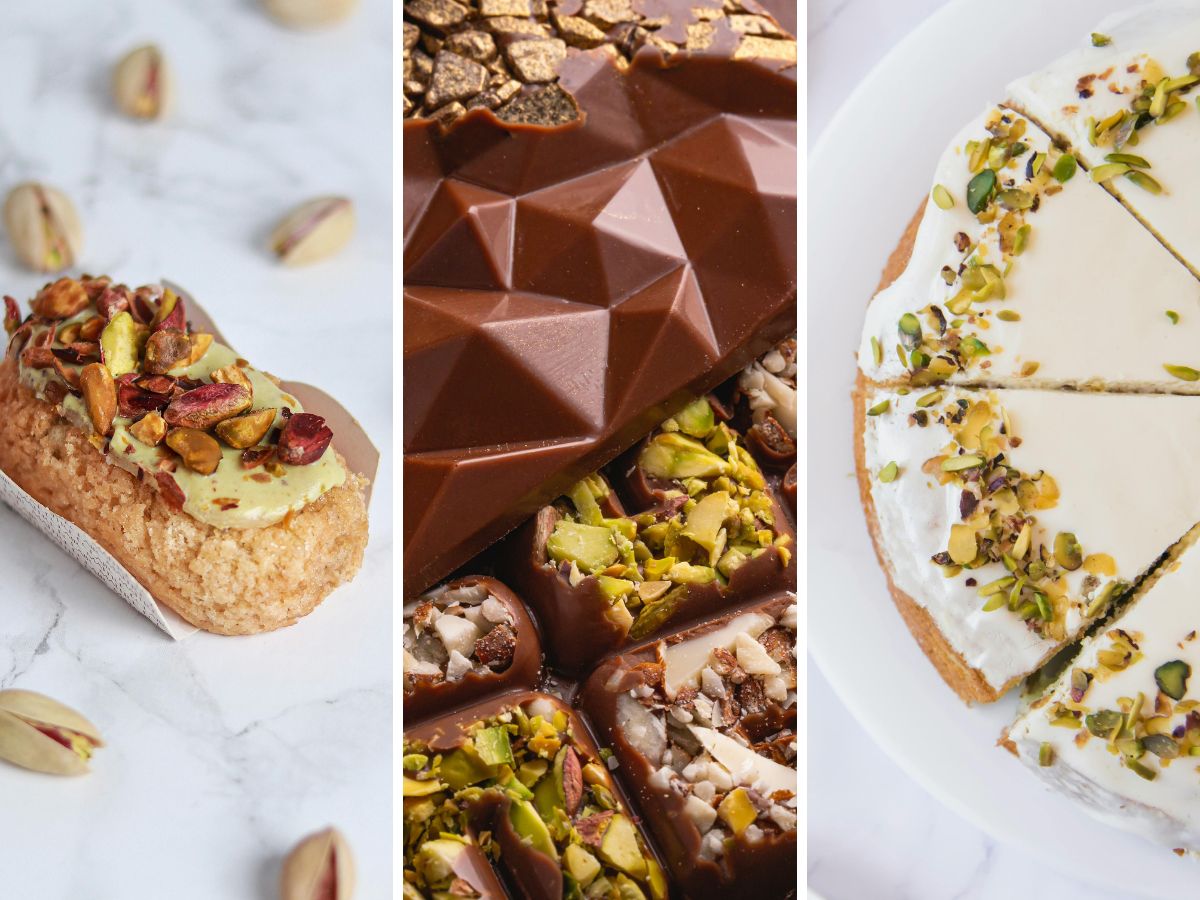

Pistachio is undoubtedly the hippest nut of today. Sidenote: pistachio is not actually a nut at all. You see it everywhere. As a filling in bars, as a bright green crumb on cakes, hello pistachio croissant or as a topping on your oatmeal. Since the Dubaireep, pistachio has had a firm grip on the Netherlands. But how green is this green hype really? Is pistachio only pleasing to the eye and nice and creamy in taste or also a healthy and socially responsible choice? We dived into it!
Why we're going wild for pistachios
Let's be honest: it wasn't just the taste that won us over. The so-called ‘Dubai chocolate bar’, filled with pistachio cream and crispy kadaif, went viral because it feels like pure luxury. Rich, creamy, a little bit over the top. And then that almost glowing green colour. That's just edible Eye candy. But pistachios don't just score points for their appearance. They are also the slightly more sophisticated sibling of peanuts and almonds. They contain all nine amino acids and pistachios contain antioxidants such as lutein and anthocyanins, which are good for your eyes. Relatively few calories for a nut too.
And there's another clever thing about pistachios. Those who have to shell their own nuts eat an average of 41% fewer of them. This is also known as the ‘pistachio effect’. Shell first, then snack. It makes a difference.
Incidentally, officially, a pistachio is not a nut at all but a drupe. What we eat is hidden in the kernel. In China, they therefore call it the ’laughing nut‘, because the split shell looks like a smile. See, this is how a hype suddenly becomes educational too.
Where do our pistachios come from?
The pistachio treePistacia vera) originates from Asia (Iran) and is a discerning survivor. It takes seven to ten years before it can be harvested for the first time. And then the pistachio is also biennial: one year the harvest is meagre, the next year the harvest is excellent, and so on. It needs hot summers and cold winters, which is why it only grows in a few specific regions. Roughly speaking, there are three areas where pistachios grow. And they all have their own price tag and corresponding footprint. We're taking you on a pistachio journey:
- Let's start in California (United States). The majority of pistachios, around 60% of the world's production, come from here. In the US, they grow the large, uniform, light-coloured pistachios you often find in supermarkets. Harvesting is done by machine here, which keeps prices stable. A downside is the pressure on nature: a great deal of water is needed for irrigation (more on that later) to achieve the enormous, consistent harvests.
- Then there's Iran (Kerman region), the cradle of the pistachio. Iran supplies some 15 to 20% of the world's pistachios, but the price and export quantities are unfortunately also highly dependent on the geopolitical tensions in this region. The Iranian pistachio is known for its intense, almost savoury flavour and deep green colour.
- In Turkey (Gaziantep) grow the very best pistachios for baklava. The nuts are smaller than American pistachios, but they are bursting with flavour. In 2025, the harvest was unfortunately poor (a good 80% less) due to extreme frost and drought.
- In Spain, Italy and Greece, pistachios are also grown. The European pistachio market is growing, which is good, because short supply chains are naturally good for your footprint. The Sicilian ‘Bronte’ pistachio (1% of world production) grows on the volcanic soil of Etna, is hand-picked, and with their protected PDO status, they are the Rolls Royce of pistachios: extremely tasty (and yes, also very pricey). In Greece and Spain, more and more pistachios are being harvested, and pleasingly, also with attention to nature. We'll come back to a nice Spanish pistachio project shortly.


Pistachio nuts are not only tasty to eat on their own, but also delicious in ice cream or cake.
Is pistachio a truly green choice for your menu?
Look, the pistachio is healthy, that's for sure. But the sustainability of the pistachio is a sensitive point. Okay, the pistachio tree is very drought-resistant. That's a big plus. They even grow better than many other trees in saltier soils, and yes, unfortunately, there are more and more of those with the current climate.
So far That sounds like a pretty good score for the pistachio. But, it's a bit of a paradox: even though the trees grow well in dry areas… they need a lot of water for a good harvest. A kilo of pistachios needs about 5,000 to 6,000 litres of water. For perspective: a kilo of hazelnuts needs 2,500 to 3,500 litres of water, walnuts 4,000 to 5,000 litres. And those two often grow in areas with more rain, so irrigation isn't necessary. To get a good pistachio harvest, a lot of irrigation water is therefore often needed. The consequences? In California, the soil in some places has already dropped by metres, due to the pumping of groundwater reserves. In Iran, irrigation causes agricultural land to become salinised (saltier). Now, pistachios can tolerate saltier soil, but many other crops cannot, and that in turn threatens local food security. Ouch!
Regarding working conditions
And then we'll take a look at how those pistachios get from the tree into a bag on your table. Then we'll see big differences between the pistachio regions. We'll take you on a journey again.
- In the United States, harvesting is almost entirely mechanised. There is little manual labour involved, so there is little risk of labour exploitation. Downside: these heavy machines do consume a lot of energy.
- In the Middle East (Iran & Turkey), cultivation is often still a traditional family process. They pick by hand. Good for the local economy, you might say. That’s right. But there is less oversight of working conditions. Furthermore, seasonal workers from the region come to help with the harvest. Sometimes entire families, including their children. Often for low wages and not always with the best living and sanitary conditions. In Turkey, there are concerns about the deployment of these seasonal workers (including refugees). The price of pistachios often largely ends up in the hands of (intermediate) traders, not the pickers.
- If you choose European pistachios, you are choosing the strictest labour laws in the world. The pickers in Spain or Greece fall under EU directives, which significantly increases the chances of fair pay and safe working conditions.
Pistachio, the green gold
Another point: the price of pistachios. A classic case of supply and demand: if demand increases, but supply remains the same (you can't conjure up kilos of extra pistachios out of thin air... ), the price goes up. And that's exactly what has happened since the Dubai bar enchanted the world in 2022. Demand for pistachios rose (as did the costs for water and labour), and prices followed suit. Add to that the fact that pistachios have a biennial cycle (meaning a good harvest every other year, with a lean harvest in the alternate year) and that the Turkish pistachio harvest in 2025 was a massive disappointment due to extreme weather... voilà, the pistachio price went through the roof. Wholesale prices increased by about 30%, from 14 euros per kilo to 20 euros per kilo. For consumers, the prices were even higher. €80/kilo was even reported for top-quality pistachios!
Tips for pistachio fans: make the greenest choice
Would you like to enjoy pistachios but without a bitter aftertaste? Then pay attention to the following points:
- Choose the EU organic logo (the green leaf). This guarantees that no synthetic pesticides have been used, which protects biodiversity in orchards.
- Look at the origin! Preferably choose European pistachios. Fewer ‘food miles’ and working conditions are more transparent than in, for example, Asian countries.
- Search for ‘Dry-farmed’. If a brand states the nuts were grown without irrigation, you've hit the jackpot for water saving.
- Choose raw nuts. Raw, unsalted pistachios in their shells are the least processed and often of better quality than their salted ‘snack nut’ counterparts.
- Consider alternatives. Are you choosing pistachios for the green colour in a dish? Then you could also choose pumpkin seeds (deliciously local!). And if it's about the crunch? Then hazelnuts or walnuts (they need less water to grow and they grow closer to home) are also a great choice.
More sustainable pistachios are a delicacy.
It's probably clear: pistachios are a tasty product, with a colour that also looks good on the table and on social media. A pistachio harvest requires a considerable amount of water and, depending on the origin, is also quite labour-intensive. That explains why they are also pricey. Pistachio is basically a luxury product, just like chocolate. Found some very cheap pistachio cream? There's a good chance the pistachios are of lesser quality or have been treated with food colouring. Do you consciously choose organic, European suppliers who take water scarcity into account and where working conditions are transparent? Lovely! Whether you're eating an Iranian, Italian, or Spanish pistachio nut, don't forget to enjoy the ‘green gold’.
You might also find this interesting
- Also hip and green: Is matcha as green as it looks?
- Often comes from afar too: Is it sustainable to eat mangoes?
- Popular on the fruit bowl: how sustainable is a banana?
Sources: Water Footprint Calculator Network, U.S. Geological Survey (USGS), International Nut and Dried Fruit Council (INC), Greendish, Vogue, Max Today, BNdeStem, ScienceDirect. Photo credits: main image left: Mehdi Bouhamed (Pexels), centre: Serghei Savchiuc (Unsplash), pistachio cake: Razaneadra (Pexels), pistachio ice cream: Bestasya (Pexels).