
One whiff and you are back with your grandmother in the kitchen, your first crush or that one holiday home in France. Scents do something to us. They touch something, bring memories to life. No wonder we love to surround ourselves with anything that smells good: from body lotion to detergent. But did you know that ‘perfume’ on packaging is actually a big mystery? What's in that yummy scent? And why do we really put it in everything? We delved into the wonderful world of perfume and discovered: it may smell good, but it is not always that fresh.
Where is perfume in everything?
When you hear the word perfume, you probably immediately think of a nice scent you spray on. But perfume is in many other products, which chances are you have in your home. Think cleaning products, washing-up liquid, laundry detergent, soap, shower gel, shampoo, toothpaste, cream, body lotion, foundation and lipstick. Perfume is even added to some nappies, handkerchiefs and toilet paper. Not to mention air fresheners. In short, a lot of fragrances end up in your nose, on your skin, in the air and down the drain every day. That's not so good for the planet, but possibly not for you either. So because you come into contact with (fragrance) substances quite often, those substances also accumulate. And it is not clear what the long-term effect of all that piling up is. So we thought it was high time to find out what perfume is actually made of, so you might want to avoid it more often. A perfume diet? Something like that!
Fragrances?
The fragrances used in all those everyday beauty and personal care products, cleaning products and air fresheners do not follow a set recipe. One care product can contain hundreds of fragrances. Just imagine how many substances you come into contact with in a day. To give you an idea: manufacturers use a total of more than 2,500 different fragrances. Sometimes these are natural ingredients, such as lavender or rose oil. Sounds nice and pure, right? But fragrances can also be synthetically developed in a factory or laboratory. Think, for instance, of certain types of musk, which are hardly biodegradable in the environment. And this is where it gets complicated. Because ‘natural floral fragrances’ may sound better for the planet, but they are not necessarily so. Some of them require huge amounts of plants to extract a little oil. That takes a lot of land, water and energy. In contrast, synthetic fragrances can sometimes actually be more efficient to make. Are you afraid of irritating substances because fragrances are made in a factory? We can be brief about that too: how and where something is made says nothing. Even natural substances can irritate the skin considerably. So fragrance substances are anything but black and white.


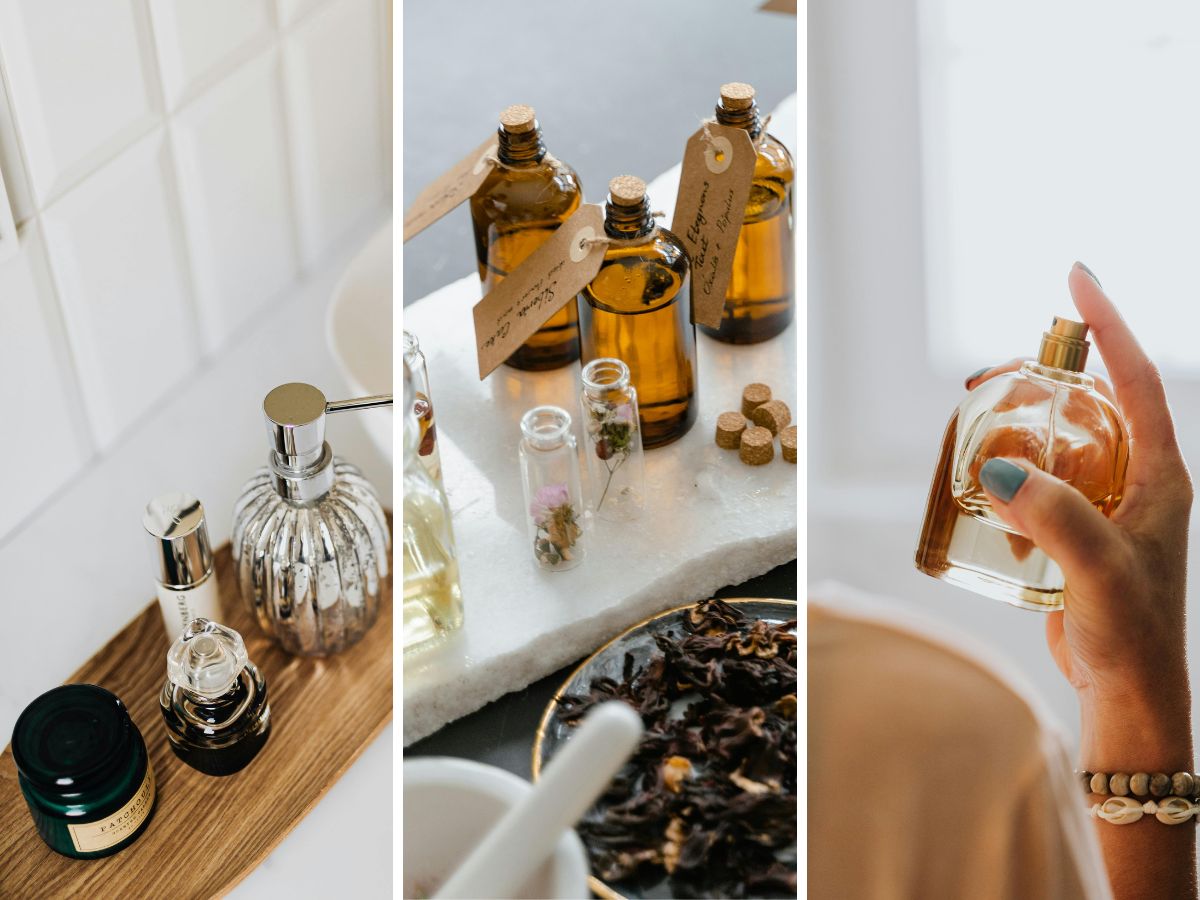
We come into contact with perfume not only when we put on a nice fragrance, but also through many other everyday products such as soap, cream, make-up and shampoo.
Choose none or a durable fragrance
Is it better to avoid perfume? If at all possible: yes. Even perfumes that call themselves ‘natural’ or ‘sustainable’ leave their mark on the environment via production, packaging or what eventually ends up in the sewer. So: those scented tissues, creams or make-up? Leave them alone and opt for a perfume-free variant. They really do exist, and - believe us - they work just as well. Still a fan of a nice scent in your shampoo or cleaner? Get it. Then pay attention to labels that say something about the origin and environmental impact of fragrances. Milieu Centraal has a handy hallmark guide for cosmetics and cleaning products, making it easier to make a more conscious choice.
Instead, are you looking for a long-lasting perfume? In this article, we tip brands that not only smell great, but are also kinder to you and the planet.
Vegan perfume
Do you still want to buy a product with perfume? Then pay attention to something else: preferably choose a variant that is vegan as well as animal-free. You might not have thought it, but perfume can contain animal ingredients such as extracts from beavers, deer or even sperm whales. Bizarre, but really true. Some of these substances have now been banned, but unfortunately this does not mean that all perfumes are automatically vegan or animal-free. Want to know more? In this article, you will read why perfume is not always vegan. There, we also delve deeper into the (headache) issue of animal testing in the cosmetics industry. Because yes, animal testing is banned in Europe, but that doesn't settle it by a long shot.
Want to be sure a product is vegan or animal-tested? Then pay attention to these labels:
- Vegan & cruelty-free: PETA-Approved Vegan, the green and white sunflower of The Vegan Society, the yellow-green label of V-Label and the certified vegan black heart of vegan.org.
- Cruelty-free: PETA-Approved or Leaping Bunny.
Sources: Amsterdam UMC, Utrecht UMC, Antidote, NRC, it canWEL, Elle. Photo credits: main image centre: Mart Production (Pexels), other photos: Karolina Grabowska (Pexels).