
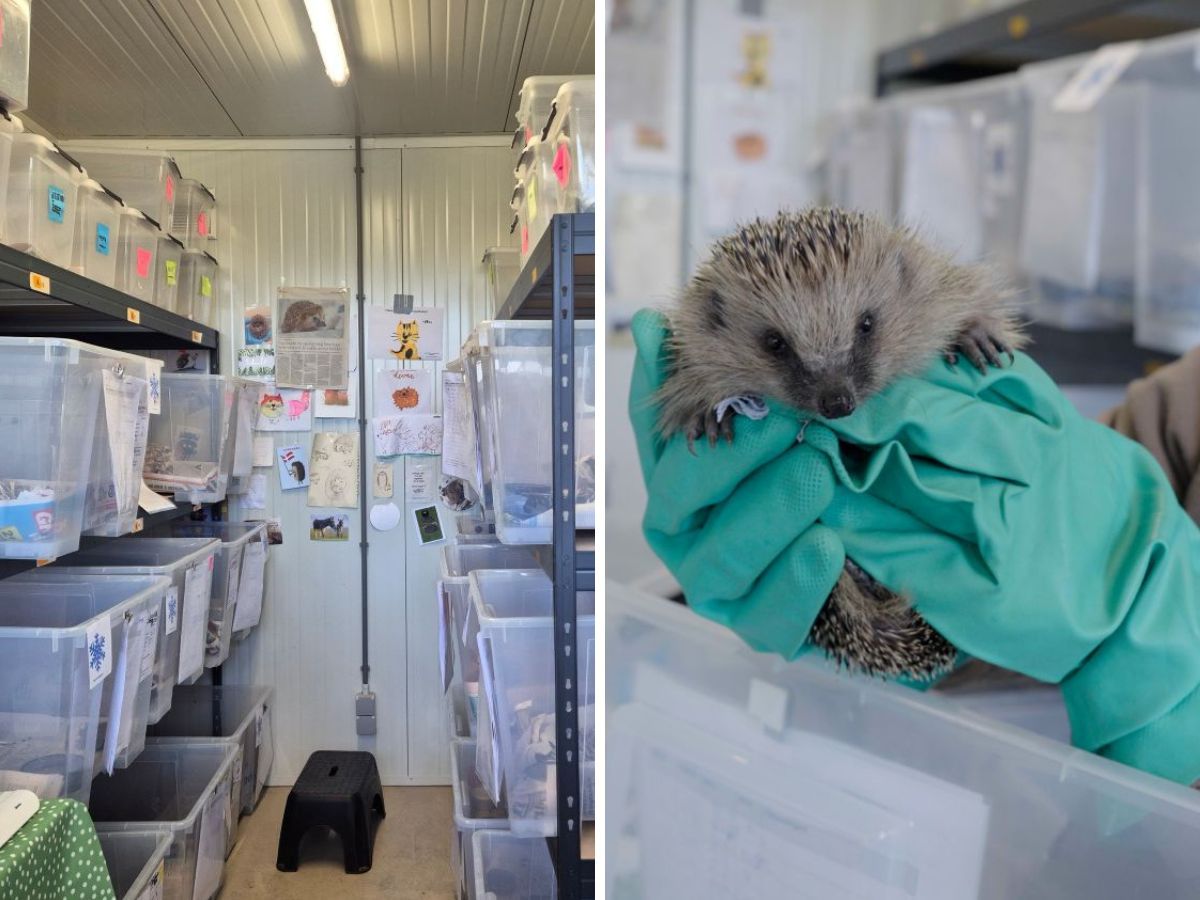

In winter, it is a regular feature in the news: the hedgehog shelter is full. Volunteers sound the alarm, as more hedgehogs come in than they can handle. We asked ourselves: how is this possible? And more importantly, what can we ourselves do so that hedgehogs do not have to end up in a shelter? Saskia paid a visit to Wild Shelter Snorhaar in Utrecht and found an overcrowded shelter, where even the canteen has been converted into a hedgehog room. This is what is going on and this is what you can do!
What happens to a sick hedgehog?
In winter, sick hedgehogs are brought into the hedgehog shelter almost every day. People find them in their gardens, on the street or in the middle of the day in the park. And the latter is almost always an alarm signal. A hedgehog is supposed to rest in winter. If you see one walking around while it is cold, something is usually wrong. At Game shelter Whiskers in Utrecht, we are given a guided tour by Frederike Lijffijt. Together with a small team of volunteers, she is looking after around 130 hedgehogs and one hare at the time of our visit.
‘In winter, we mainly see animals that have not built up enough fat reserves,’ she says. A hedgehog the size of a mango in autumn is simply too small to survive the winter. They then have too little fat to enter their hibernation properly. As a result, they become weakened and susceptible to bacterial infections, pneumonia and parasites such as lungworm. Fleas and ticks can also further deplete an already weak hedgehog. So a hedgehog wandering around during the day in winter is usually not cute or curious, but just in need.


Visiting the hedgehog shelter at wildlife sanctuary Snorhaar where 130 hedgehogs in need are helped during the visit.
First aid for hedgehogs in distress
Once inside, each hedgehog is first examined. How heavy is he? Is he dehydrated? Are any wounds or parasites visible? Sometimes the faeces are also examined to check for internal parasites, such as lungworm. Based on this, hedgehogs are given medicine if necessary. Then they are given a name, really, and their own pen, sometimes together with another hedgehog if appropriate. If you look closely, you will see that they are all slightly different. Some have a pointier nose, others a darker head or lighter fur. No hedgehog is exactly the same.
They are supplemented, usually with hard cat food and water, until they regain their weight and strength. Some hedgehogs still go into hibernation at the shelter. By the way, this is a common misunderstanding: hedgehogs do not hibernate for one long hibernation of months in a row, but have several shorter sleep periods. Once a hedgehog has recovered sufficiently and is strong enough to fend for itself, it is released again, often in the place where it was found.
When is a hedgehog in distress?
So when should you intervene or not? According to Frederike, that depends a lot on the season. In autumn and winter, a hedgehog the size of a mango is too small. It will probably not survive without help. A hedgehog that walks around during the day while it is cold, looks apathetic or does not roll up when touched, also needs help. In spring and summer, things are different. Then you sometimes see young hedgehogs wandering around alone. That seems pathetic, but it is not automatically a problem. In doubt? Always call a hedgehog shelter for advice before taking a hedgehog away. Unnecessary picking up is also stressful for the animal.
This is how to help hedgehogs without them ending up in the hedgehog shelter
The hedgehog's biggest threat? That's us. Our gardens are tightly tiled, neatly raked and enclosed with dense fences. Nice and tidy for us, but a disaster for a hedgehog. They find little food and often have nowhere to go. By the way, a hedgehog does not only eat snails, as is often thought. In fact, snails can carry parasites that make hedgehogs sick. What do they prefer to eat? Beetles, caterpillars, worms and other insects. And let that be exactly what is becoming increasingly scarce. Not only because of all those tiles, but also because of the use of pesticides. Poison against weeds and insects reduces soil life. Fewer insects means less food for hedgehogs. And fewer insects also means less food for birds and other animals. So the whole ecosystem gets out of balance. A garden without buzzing may look neat, but in fact it is grimly quiet.
What can you do? Leave a corner of your garden nice and messy. Think leaves, branches and a pile of prunings. Hedgehogs can hide there and sometimes even make their own nest. Do you have a wooden fence? Make a small opening at the bottom so that hedgehogs can walk from garden to garden. They need a large habitat and now often get trapped. See a small or skinny hedgehog in autumn? Then you can temporarily put down some hard cat food and a bowl of water. This is not a structural solution, but an emergency measure. In an ideal world, they just find their food on their own.
Hedgehogs in the Netherlands are not doing well
The hedgehog is perhaps one of the best-known wild animals in our garden. But it has not been doing well for years. Due to urbanisation, petrified gardens, heavy traffic and the disappearance of insects, the number of hedgehogs is declining. Exact figures vary from study to study, but wildlife organisations have been speaking of a worrying decline for some time. And that's not just sad, it says something about our biodiversity. Hedgehogs are insectivores. They help keep your garden's ecosystem in balance by eating beetles, larvae and other small critters. Fewer hedgehogs often also means: fewer insects, fewer hiding places, less nature. So think of the hedgehog as a yardstick. Does it feel at home in your garden? Then the variety of plants, insects and hiding places is usually fine. If you take good care of the hedgehog, you will automatically help many other species. See also: this is how to help hedgehogs in the garden!
You might also find this interesting!
- Also see: Visiting the fish shelter.
- Also see: donation to the pathway.
Photo credits: Fleur Kuijf.