
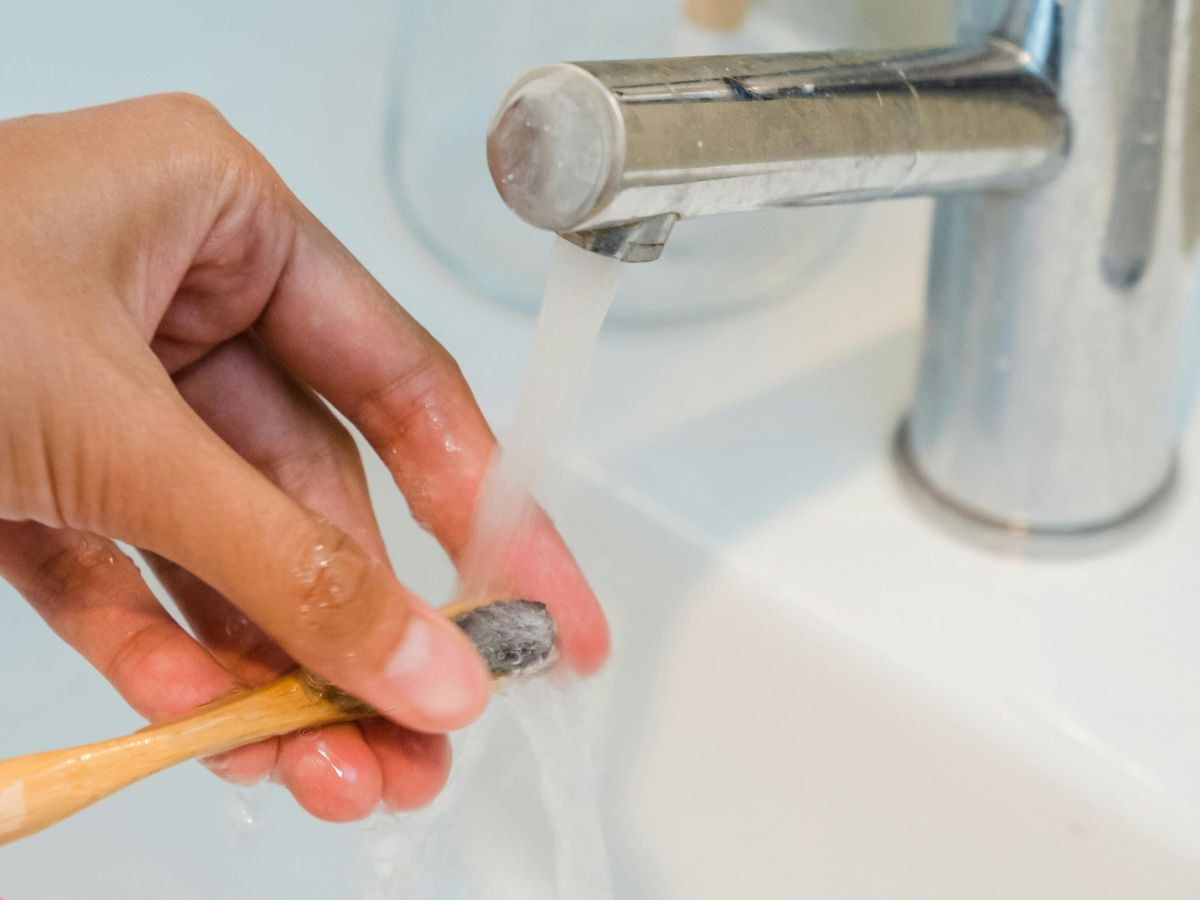

Brush your teeth well twice a day and you will see within no-time That your toothbrush and charger turn brown and white. Or that there's grime in the neck of your brush head. Not fresh. And this is even when you clean the brush heads neatly. How can an electric toothbrush get dirty so quickly? And more importantly: how do you clean it properly without aggressive agents? We looked into it.
What is that brown residue on your electric toothbrush?
What happens to your toothbrush after you've neatly brushed your teeth and rinsed it clean? Because when you look a day later, there’s suddenly a nasty residue that you didn’t see when you put it back. That brown film arises from a simple sum of saliva, toothpaste and water. After brushing, you rinse your brush and put it back on the charger. Check. But it never dries completely. Some moisture always remains in the neck of the brush head and around the handle. And that moisture contains saliva. Saliva is quite an active substance. It's full of enzymes and bacteria that help break down food in your mouth. Outside your mouth, they don't do anything useful anymore, but they do cause residues to dry out faster and form a sticky layer. A bit like a thin layer of syrup drying out. Something always remains of that too.
Add limescale from tap water and dust from the bathroom to that, and you get layer upon layer. Especially in a warm, humid room, that happens faster than you think. And that's how you get that brown film on your charger or around the edges of your brush. Yuck.
By the way, the build-up isn't just on your charger. Take a good look at the neck of your brush head. All sorts of things get stuck in the small edges and holes. You don't notice it straight away, but it slowly accumulates. Everyone's always talking about the bristles on the brush head. You should replace those in good time, naturally. But it's often under the head and in the connection point where most of the gunk is found. Water gets in there, but it dries less well. In short, the ideal place for limescale and bacteria to settle. So, an extra reason to take not only your teeth, but also your toothbrush seriously.
Cleaning an electric toothbrush with water and white vinegar
Fortunately, you don't need complicated cleaning products. You can simply clean it with what you probably already have at home. Mix two parts boiling water with one part distilled vinegar or white vinegar. Remove the brush head and leave it in the mixture for about thirty minutes. This helps to loosen limescale and break down grime. In the meantime, wipe the handle and charger with a cloth dipped in the same mixture. Please note: never submerge the electric handle completely in water. Afterwards, rinse the brush head thoroughly with clean water and allow everything to dry completely before reassembling it. Do this about once a week. This will prevent that brown layer from continuing to build up.
You can read more cleaning tips with natural vinegar here, because it's a real powerhouse.
Is an electric toothbrush sustainable?
We get at thegreenlist.nl There's often the question of whether an electric toothbrush is a sustainable choice. It's an electronic device. Once it's broken, it's difficult, if not impossible, to repair. And a manual toothbrush is, of course, simpler. Yet we say: yes. Electric brushing is often recommended by dentists. And if anything is truly sustainable, it's taking good care of your teeth. Every treatment you prevent saves materials, energy, and waste. Prevention almost always wins over repair. You can read more about sustainable oral care here. The condition is, therefore, that you get good use out of your electric toothbrush. So, clean it regularly and replace the brush head on time. Does your brushing buddy unexpectedly break down? That's a shame! Then hand it in as small electrical waste!
Sources: @madamesweat (Instagram). Photo credits: Greta Hoffman, Pexels.