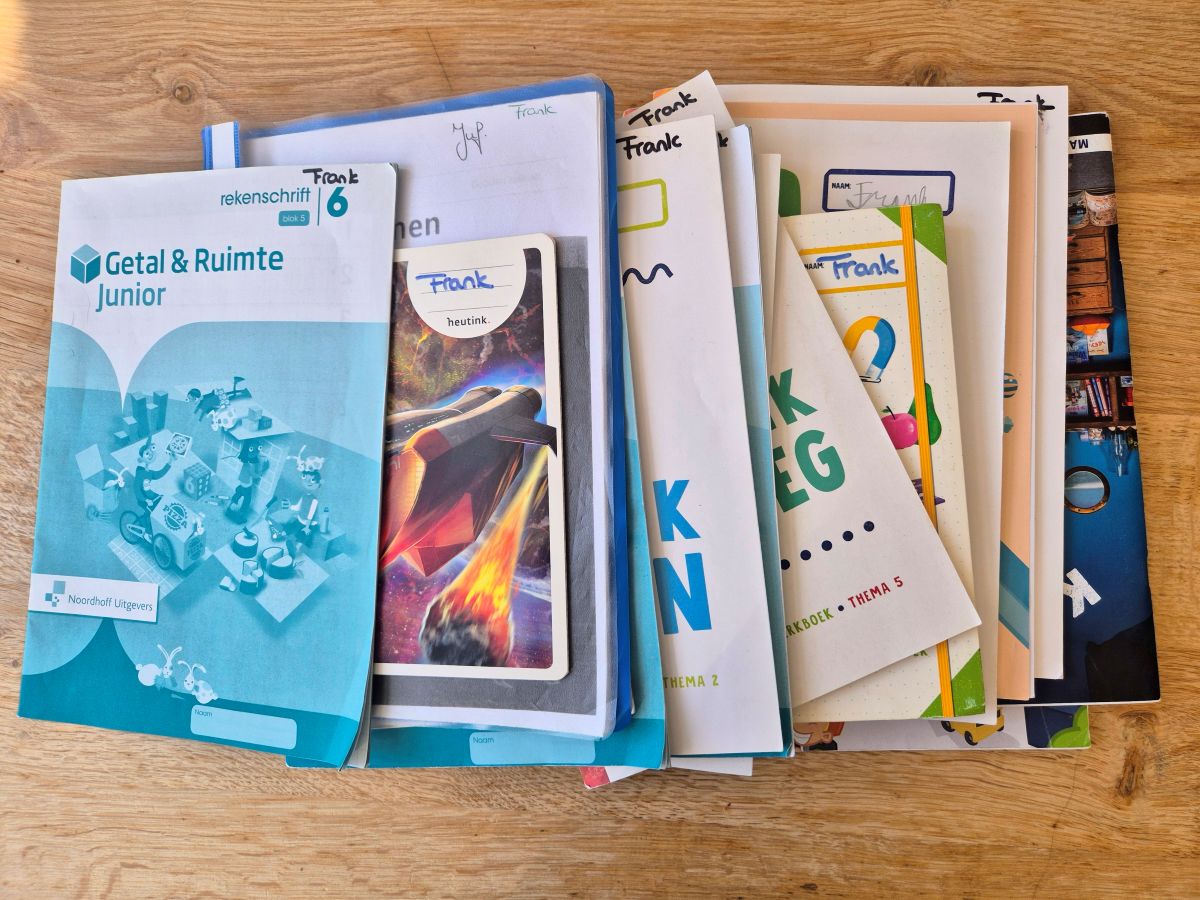

The school year is almost over, and Saskia is scratching her head. So much has come into the house again this year. Stacks of notebooks, most of them still half-empty. Workbooks that have barely been used. It feels like such a waste. So she wondered: how big is the waste of schoolbooks actually? We investigated. The answer shocked us.
How large is the waste of schoolbooks, actually?
Millions of school textbooks end up in the bin every year. This is according to research and reports from sources including the NOS. In secondary schools alone, it's thought to be over seven million kilograms of disposable books per year. These are books that students write in and are discarded after just one school year. These figures relate to secondary education, but they do make us think. Because if that much paper is being thrown away, what happens in primary schools? In our household, we also see piles of half-filled notebooks and barely used workbooks coming back, for certain.
Waste in secondary schools is a big issue.
Waste has now become structural in secondary schools. Since 2019, many schools have been working with a combination of a digital licence and a paper workbook that students are allowed to write in. That book is no longer collected at the end of the school year. In the best-case scenario, it goes to paper recycling, or worse: to general waste. For some school communities, this amounts to tens of thousands of kilograms per year. It used to be different. You probably remember that yourself. Textbooks lasted for four to six years. You would pick up a stack of books at the start of the year, cover them neatly, and hand everything back in at the end. Writing in your book was forbidden. That system might have been a bit more cumbersome, but books did go through multiple cycles. The fact that we are now doing this differently on a large scale has not gone unnoticed. The House of Representatives also wants to drastically reduce the number of disposable books and is investigating how this can be done more sustainably.
School textbooks as a disposable product are big business
Naturally, there are also commercial interests behind this system. The school textbook market is largely dominated by a few large publishers, such as Malmberg, Noordhoff, and ThiemeMeulenhoff. They often offer schools a package of a digital licence with a printed workbook. In that model, a new book is needed every year. Do the maths. There are over nine hundred thousand students in secondary education. With an average of ten subjects per student, that amounts to some nine million books per year. Books that are discarded after one school year. That’s not an afterthought, that’s the system. What’s problematic is that many of those workbooks still instruct students to write their name and class in them. This immediately makes reuse impossible. Some schools are now trying to break this cycle. They put stickers over that instruction or agree with students that they shouldn't write in the books, so they can still be used for another round. So, it can be done. But it requires a different choice.


Waste of textbooks: blank notebooks, half-filled workbooks, but also hardcover workbooks that could easily be used for several years if you wrote the answers in a separate little notebook.
Less textbook waste?
And then you find yourself with a stack of books in your hands. What's the solution? Honestly, we don't have a quick answer for that either. This is a systemic issue. But doing nothing feels strange too. What you *can* do is start small. Have a conversation with the school. Ask how they deal with workbooks. Is reuse discussable? You could, for example, suggest they look at the cooperative schoolbook publisher. Neon. This initiative attempts to organise textbooks differently: schools, teachers and creators collaborate on flexible, more easily adaptable teaching materials. The idea behind this is that teaching materials will become outdated less quickly and will be more reusable. This not only saves paper but also costs and waste.
And if the books are no longer accepted anyway, at least make sure they end up with the waste paper. That makes a difference. In the Netherlands, waste paper is largely recycled into new paper and cardboard. If you throw books in with the general waste, they are incinerated. This generates some energy, but the paper is permanently lost. Recycling also costs energy, but saves trees and raw materials. It's not a perfect solution, but it's a better one.
ALSO INTERESTING: This is how the Kringloop deals with unsaleable books!
Back to the old school textbook system?
Was everything better in the past? No. But when it comes to school textbooks, perhaps a little. Books lasted for years, were passed down, and you learned to take care of them. Otherwise, you could count on a fine. And nobody wanted that nagging from their parents. Now we've swapped that for disposable books, often combined with digital teaching methods. And we haven't even mentioned the additional consequence: more screen time. While eye doctors warn that myopia among young people is increasing explosively. In the Netherlands, about half of teenagers are now myopic. Too much looking close-up, too little time spent outdoors. The well-known 20-20-2 rule is not actively encouraged at every school by a long shot. But that might be a topic for another (next?) article. Keep thegreenlist.nl definitely follow.
Do you have a tip? Does your school do things differently? Or does your school do things smarter? Let us know. Because this is a subject where you think: surely this needs more thought.