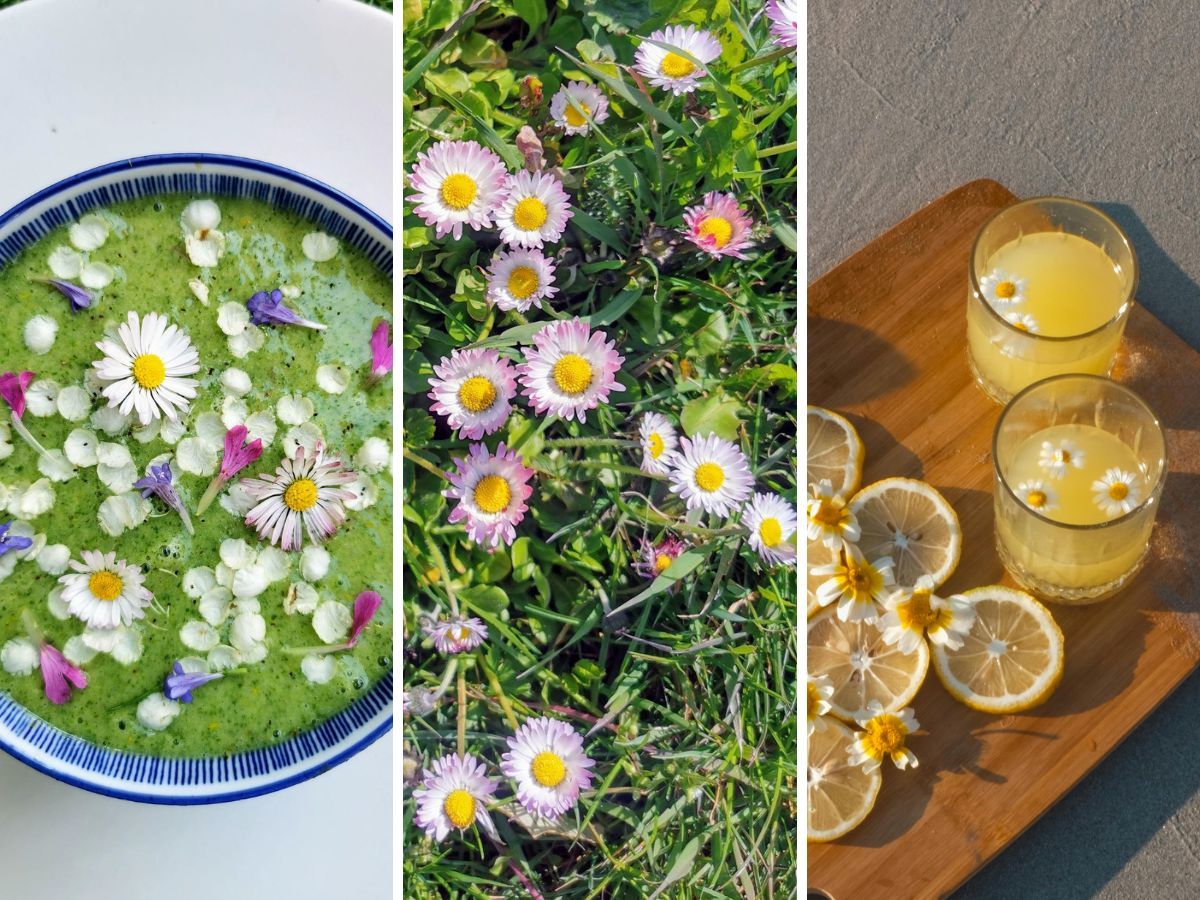
Did you know that daisies are edible? These small flowers that you find everywhere in meadows and parks can be surprisingly well used in the kitchen. In the spring, for example, you can make a mild, floral daisy syrup from them, perfect for tea, sparkling water, or over yoghurt and pancakes. Wild food expert Katja Wezel from wilderlust.nl show how to make this foraged syrup.
Daisies are edible flowers
Daisies are small, perennial plants from the composite family that you can find almost anywhere: in meadows, parks and verges. They flower for a large part of the year and are easily recognised by their yellow centre with white petals, which sometimes turn light pink. Both the flowers and the young leaves are edible. Their taste is mild and fresh, with a slight bitterness. Traditionally, daisies have been used in folk cooking and medicine. They contain, among other things, bitter substances, saponins and antioxidants and are known for being mildly purifying and beneficial for digestion. A surprisingly versatile little flower that can do more than you might think.
Where do you find daisies and when do you pick them?
Daisies can be found wherever grass grows: in parks, lawns, meadows, verges, and public gardens in the city. They bloom from February to October and can even withstand light frost. For syrup, it's best to pick them in spring and early summer (April–June), when the flowers are fresh and abundant. It's preferable to harvest before midday, after the dew has evaporated, and only pick flowers that have not yet fully bloomed. After picking, lay your harvest on a tea towel for a while so that small creatures can crawl away.
Daisies can, at first glance, be confused with other composites, such as chamomile and oxeye daisy. These plants are not poisonous, but they do differ in taste and use. Daisies stay low to the ground, have one flower head per leafless stem, and grow from a leaf rosette. Chamomile and oxeye daisy grow much taller and have leaves attached to the stem. Daisies have a mild flavour and are suitable for the kitchen, chamomile is mainly used medicinally, and oxeye daisy is primarily an ornamental plant. Always take the time to identify them properly before picking, as this makes foraging enjoyable and carefree.
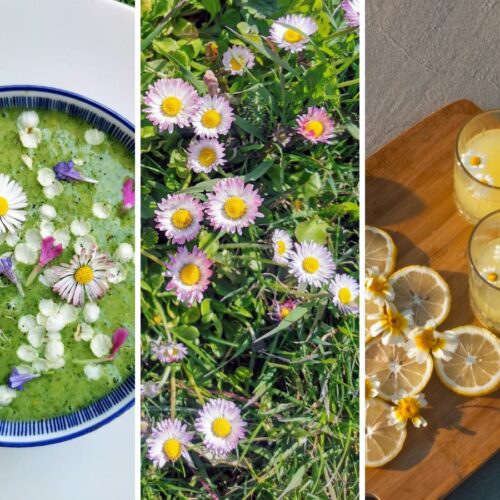
Making daisy lemonade
Kitchenware
- pan
- sieve
- Mortar and pestle or spoon
- clean bottle or jar
Ingredients
- 25 g verse madeliefjes Blade, steel and open flower heads
- 600 ml water
- ¼ organic lemon Peel and boil
- 2 el Rose water
- 20 ml Apple cider vinegar
- 60 Daisy tincture drops
- 50-75 ml Maple syrup
- 1 dried hibiscus flower optional
Instructions
- Gently bruise the leaves in a mortar and pestle or with the back of a spoon.
- Put the crushed leaves, flowers and stems in a pan along with the water, lemon juice and lemon peel. Add the hibiscus flower if desired. Make sure everything is submerged.
- Heat the mixture until it is just below boiling point and let it steep for about 3 minutes, without allowing the water to actually boil.
- Take the pan off the heat, put the lid on and leave the mixture to steep for a day.
- The next day, strain the mixture and collect the liquid in a clean (!) bottle or jar. How to clean glass jars and bottles thoroughly? First, pour boiling water over them (don't forget the lid) and then place the jar/bottle in an oven at 100°C for ten minutes.
- Squeeze the flower parts well; they contain lots of valuable moisture.
- Next, add the apple cider vinegar, rose water and maple syrup. Finally, add the daisy tincture.
- Close the bottle or jar and shake well. The syrup will keep for about 1½ months in the refrigerator.
Neat game picking
Foraging and creating your own recipes is great fun, but don't forget: foraging is officially forbidden in the Netherlands and is often only tolerated. In some places stricter rules apply or it's strictly prohibited. And you're also not allowed to pick certain species. So always forage with respect for nature: only for your own use, never take more than you need, and leave enough for animals and other nature lovers. Want to know more about what to look out for? Here is a handy overview of the game picking rules.
Would you also like to go on the road with Katja? Check out her website wilderlust.nl with all the information about its wild-picking walks and courses.
You might also find this interesting
- Also see: Making dandelion syrup.
- Also see: Making elderflower cordial.
- Also see: make pine syrup.
Photo credits: left and centre: Wilderlust, right: Hello Aesthe, Pexels (lemonade).